The 1% Club’s “Hardest Ever” Final Puzzle Left Nine Contestants Stumped in Just 30 Seconds
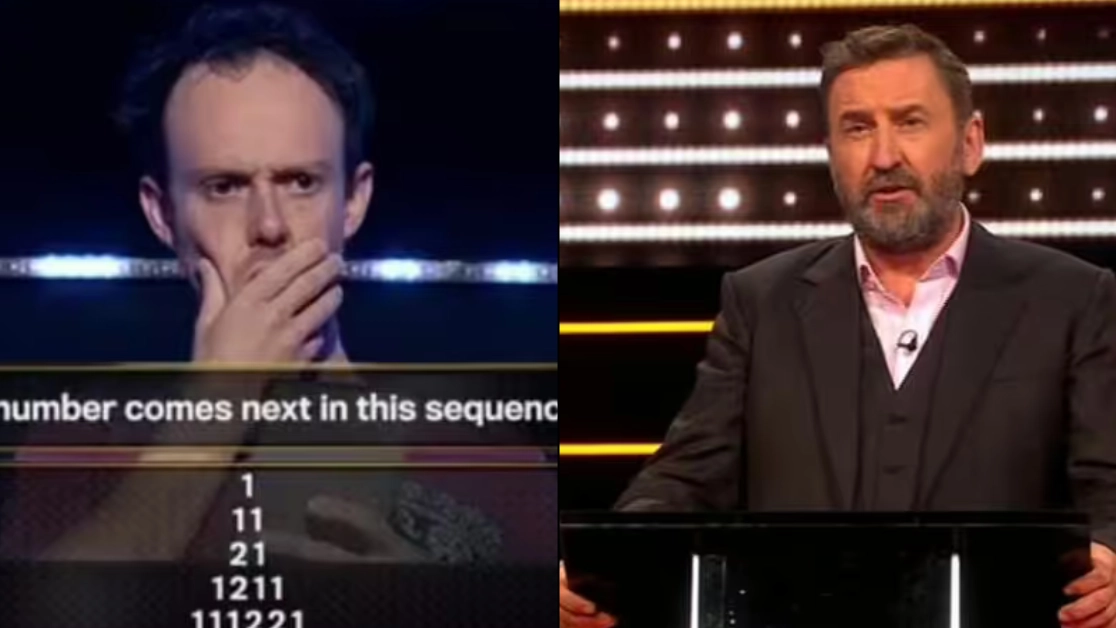
A seemingly simple number sequence proved to be a nightmare for contestants on the Australian version of The 1% Club, with all nine finalists failing to solve what some viewers called the show’s “hardest ever” final question.
Published on December 12, 2024, the challenge gave players just 30 seconds to identify the next number in a sequence. While the solution becomes much easier once the underlying trick is understood, contestants had to work it out under intense time pressure.
The question was straightforward: What number comes next in this sequence?
1
11
21
1211
111221
312211
With only half a minute to study the numbers, players had to identify the rule connecting each line to the next. But despite reaching the final stage of the quiz, none of the nine remaining contestants managed to find the correct answer.
Viewers Divided Over the Fiendishly Difficult Challenge
The puzzle quickly attracted attention from viewers, many of whom questioned whether 30 seconds was enough time to solve it without having encountered the sequence before.
Some described it as potentially the toughest final question in the programme’s history, while others admitted that they would have struggled to crack it within the time limit. One reaction suggested they would be amazed if anyone could solve it that quickly, while another pointed out how difficult the challenge would be for someone unfamiliar with the pattern.
However, not everyone was defeated by the brainteaser. Some viewers said they had worked out the answer, highlighting the difference between recognising a familiar puzzle and discovering its logic for the first time under pressure.
As is often the case with The 1% Club, the challenge was less about complicated calculations and more about understanding precisely what the question was asking contestants to notice.

The Hidden Rule Behind the Number Sequence
The key to solving the puzzle is to stop treating the numbers as ordinary mathematical calculations. Instead, each line describes the digits appearing in the line before it.
The sequence begins with a single 1. Because the first line contains one digit 1, the next line becomes 11, meaning “one 1”.
The following line, 21, describes the two digits in 11: there are two 1s.
The same principle continues throughout the sequence. The line 1211 means there is one 1 followed by one 2 and then one 1. The next line, 111221, describes the previous line as three 1s, two 2s and one 1.
Once this rule is recognised, the final step becomes much easier.
The last given number is 312211. Reading it in groups, it contains one 3, one 1, two 2s and two 1s. Describing those digits in the same way produces the next number:
13112221
That is the answer the contestants were looking for. The sequence is known as the look-and-say sequence, in which each term describes the digits of the preceding term rather than following a conventional arithmetic progression.

Another Final Question Left UK Contestants Out of the Running
The Australian challenge was not the only The 1% Club final puzzle to catch contestants out. A recent episode of the UK version also saw multiple players eliminated by a question involving an ice cube with the number 8 inside it.
Contestants were asked to work out the word represented by the picture. The answer was “incubate” — a play on the phrase “in-cube-eight”.
The visual wordplay proved difficult enough that none of the contestants who reached that stage managed to solve it in time. In total, eight players were eliminated by that question.
Although the two challenges relied on very different types of reasoning, both demonstrated how easily an apparently simple puzzle can become difficult when contestants have only seconds to think.
The Australian number sequence eliminated nine finalists, while the UK ice-cube question knocked out eight. In both cases, success depended on spotting the intended connection rather than simply relying on quick calculations.
For viewers at home, the challenge remains the same: can you recognise the hidden rule before the countdown reaches zero?