Her mother’s room still smelled of old perfume and polished wood. Even though it had been weeks since the funeral, everything seemed untouched, as if the woman would come in at any moment, open the closet, and look for a shawl or a pair of gloves.
For Mara, however, the room had nothing alive in it anymore. It was just a space full of objects that needed to be sorted, thrown away, or packed.
Mara was the kind of woman who had no patience with nostalgia. Raised in luxury, accustomed to always looking ahead, she didn’t understand why people became so attached to old things. That morning, she had come in determined to empty her mother’s closets and get everything done as quickly as possible.
Next to her sat Elena, the woman who had worked in their house for almost thirty years. She had been, in everyone’s eyes, the family’s faithful servant. Silent, discreet, always with small steps and lowered gaze. But in reality, Elena had seen more in that house than the relatives, the guests, or even Mara had seen.
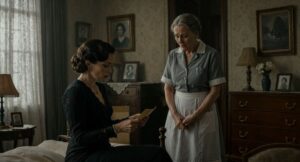
Several boxes had already piled up on the floor. Some with clothes, others with albums, others with objects Mara didn’t even want to hear about. She opened another box and took out a pair of old shoes, made of dark leather, worn at the toes.
He raised his eyebrows in irritation.
“Throw this box away. It’s worthless.”
Elena started. Her gaze stopped on her shoes so suddenly that Mara noticed immediately.
“Don’t do that,” the woman said.
Mara turned to her, surprised not by the words but by the tone. It was no ordinary plea. It was fear.
“Why would you care about some old shoes?”
Elena clasped her hands in front of her. She seemed to be struggling with herself. For years she had been silent. For years she had guarded things that did not belong to her. But now the mistress of the house was dead, and the truth risked ending up in the trash along with some objects deemed useless.
— Because your mother hid the letters in them.
There was an oppressive silence in the room.
Mara looked at the shoes in her hand as if they had suddenly become something foreign.
“What letters?”
Elena hesitated.
“Letters that the lady didn’t want anyone to find. She hid them there because no one would ever look in old shoes.”
Mara set the box on the bed and picked up one of the shoes. With trembling fingers, she touched the insole. It was slightly loose at one corner. She lifted it and immediately saw the yellowed edges of carefully folded envelopes.
His breath caught.
In the other shoe were two other letters, equally old, carefully hidden. He took them out and looked at them. The paper was thin, fragile, and on each envelope was written, in elegant handwriting, his mother’s name.
— Whose are they?
Elena raised her eyes, for the first time without immediately lowering them.
— From the man she loved before she got married.
Mara remained motionless.
All her life she had believed that her parents had been a perfect couple. That was how they looked in pictures, at dinners, on vacations, in front of the world. Her father had been stern, respected, always mindful of his image. Her mother had been elegant, calm, and discreet.
He had never thought that there could be another story behind this appearance.
— I don’t understand…
Elena took a deep breath.
— The lady loved someone else before marriage. But the family decided otherwise. She chose security, a name, wealth. The letters remained the only thing she could not throw out of her heart.
Mara opened one of them. She didn’t read it all at once. Her eyes stopped on the first few lines, and it was enough for her to understand that this was not a simple affair. It was true, painful love, kept alive for years in words that no one was supposed to see.
In the letter, the man told his mother that he was still waiting for her, that he could not forget her, and that he would always hold out hope that one day he would find the courage to live the life he wanted.
Another envelope spoke of a last missed meeting.
Another one about a child who deserved to know the truth someday.
Mara felt her knees go weak.
“A child?” she whispered.
Elena closed her eyes for a moment.
“I don’t know exactly what she meant. The lady never told me everything. But I know she cried after reading them. And I know she hid them again, every time, in the same shoes.”
Mara sat on the edge of the bed with the letters in her hand. She felt that the image of her mother, which she had thought was clear and complete, was beginning to crack.
Not because they discovered something shameful.
But because he had discovered a woman he had never truly known.
“Why didn’t he tell me?”
Elena answered slowly:
“Maybe because some women live their lives the way they are told, not the way they want to. And the only place they can tell the truth is in a hidden letter.”
Mara looked at the old shoes again. A few minutes before she had considered them trash. Now she saw them as silent witnesses to a life her mother had half-lived.
He understood then something he had never understood: the value of a thing lies not in its price, but in the story it has preserved.
The box remained on the bed.
The shoes were no longer thrown away.
And Mara left the room with the letters clutched to her chest, feeling that for the first time she was discovering not only her mother, but also the gap between the perfect appearance and the silent truth in a family.
Sometimes the most precious things aren’t the ones you inherit in plain sight.
They are the ones hidden in modest places, where only pain knew how to guard them.