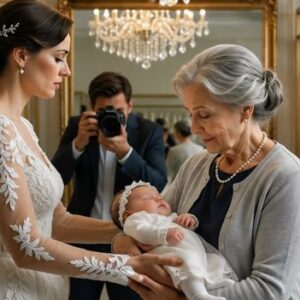
The bridal shop looked like a white hall from a movie. Long dresses hung on gold racks, large mirrors reflected warm light, and in the middle was a small platform where brides saw themselves for the first time in their dream dress. For many women, it was a place of excitement. But for some employees, it had become a place of quick judgment.
Mrs. Florica had entered the store with her daughter, Daria. She was wearing a simple beige coat, comfortable shoes, and an old but clean purse. She didn’t feel at ease among the expensive dresses and elegant mirrors, but she had come for her daughter. She wanted to see her bride, to see her happy, to be close to her on the day she chose the dress.
Daria was excited. For months she had been collecting pictures of models, jotting down ideas, and dreaming of a simple but elegant dress. Her mother had always told her the same thing: “You choose what you like, Mom. I’ll handle it.” And she had. She had saved up, given up things for herself, and agreed to pay for the dress, even though no one outside would have guessed it from her modest outfit.
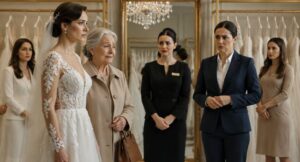
The store’s consultant, Alina, greeted them with a cold smile. She didn’t look at them as customers, but as women who had perhaps gotten lost in a place too expensive for them. She looked at Florica’s purse, at her shoes, then at Daria. Her smile became polite but sharp.
— Do you have an appointment?
— Yes, Daria answered. By the name of Daria Popescu.
Alina quickly checked her tablet and led them to the fitting area. After a few minutes, Daria saw a dress sitting separately, with fine lace and an elegant cut. Her eyes lit up.
— Mom, this is gorgeous.
Mrs. Florica smiled. She lightly touched the edge of the material, without pulling it, as if she was afraid of damaging something.
“Try this, Mom. I feel like it’ll do you good.”
Alina approached immediately.
— This dress is not made for the poor.
The words fell like a slap in the face.
Daria froze. Florica pulled her hand away from the material and looked at the consultant. She wasn’t angry. She was hurt. Deeply hurt. But her voice remained calm.
— I want my daughter to try it.
Alina smiled superiorly and pointed to another, more secluded stand.
— Maybe you should choose something more for yourself.
The store was quiet. Another bride, who was by the mirror, turned discreetly. A colleague of Alina’s looked down. No one intervened. As usual, polite humility was passed off as “professionalism.”
Daria slowly emerged from the fitting room. She had already changed into her first dress and was wearing a white fitting gown. She heard the last sentence. She saw her mother’s face, her hand clutching her purse, and the shame she was trying to hide.
“What did you say?” Daria asked.
Alina turned around, trying to regain her businesslike tone.
“Nothing serious. We were just trying to point you towards more suitable models.”
Daria took a step next to her mother.
— More suitable for whom?
The consultant responded with the same cold smile.
— For your budget.
Daria looked at her directly.
— You’re talking to the woman who pays your salary.
Alina was left speechless.
— Here you go?
“My mother pays for the dress. My mother pays for the wedding. My mother worked for years so that I wouldn’t feel the deprivations she felt. And you decided, after a simple coat, that a dress wasn’t worth touching.”
Florica tried to touch his arm.
“Never mind, Mom. There’s no need.”
Daria didn’t stop.
— It is necessary. Because too many people like her are silent and too many people like you think their silence means they are right.
Alina blushed.
— I apologize if there was a misunderstanding.
“There was no misunderstanding. There was an exact understanding,” said Daria. “You said the dress was not for the poor.”
At that moment, the store manager came out of the back office. She had heard the conversation. She was a woman in her late fifties, elegant but with a serious look.
“What’s going on here?”
Daria pointed to her mother.
— My mother was humiliated because she didn’t look like a rich client.
Alina tried to intervene, but the manager raised her hand.
“Did you say what I hear you say?”
The consultant was silent. Her silence was enough.
The manager turned to Mrs. Florica.
“I apologize. Honestly. This is not the attitude I accept in my store.”
Florica nodded slowly.
“I don’t want a scandal. I just came to see my bride.”
That hurt Daria more than the insult. Her mother hadn’t asked for respect for her. She had only asked for the right to enjoy her child.
The manager took the dress off the rack and handed it to Daria.
— You will try it. And if you like it, we will do everything in our power to make this experience as it was meant to be from the beginning.
Daria looked at her mother.
“Do you want me to try it?”
Florica smiled with wet eyes.
“Yes, Mom. That’s what I came for.”
A few minutes later, Daria came out of the booth wearing the dress. The store seemed to be lit up differently. The dress was exactly what she had dreamed of: delicate, elegant, without being exaggerated. Florica put her hand to her mouth and started to cry.
— You are beautiful, my girl.
Daria got off the platform and hugged her mother. She no longer cared about the mirrors, the price, the consultant, or the other people in the store.
— If you say it’s the dress, then it’s the dress.
Alina stood aside, her face pale. The manager called her to a corner and told her softly, but firmly, that a bridal shop doesn’t just sell dresses. It sells memories. And an employee who turns a mother’s memory into humiliation has no place there.
After they left, Mrs. Florica walked on the sidewalk next to her daughter, holding the receipt in her bag. She walked slowly, but seemed to be walking straighter.
“Mom, don’t be upset about what that girl said,” she said.
Daria stopped.
“I’m not upset about the dress. I’m upset that it hurt you.”
Florica looked down.
“I’m used to it, Mom. People look at the clothes before they look at the person.”
— Then I don’t want to get used to this.
On her wedding day, Daria wore that dress. Before entering the hall, she called her mother to her side and arranged the brooch on her chest.
“I want us to be in pictures together,” Daria said. “You’re the reason I’m wearing this dress.”
Florica cried again, but this time not from shame. From joy.
And later, when people asked where the dress was from, Daria simply replied:
— Mom chose it.
He didn’t say how much it cost. He didn’t say who was humiliated. He didn’t tell the story in front of everyone. But in every photo, next to the bride, stood a woman in a simple dress, with gentle eyes and hardworking hands.
The woman someone had considered too poor for an expensive dress.
The woman who had made it possible for her daughter to feel like a bride.
Because the value of a mother is not seen in her purse, shoes, or label. It is seen in everything she gave without asking to be seen.
And a wedding dress is never too elegant for the woman who worked her whole life so her daughter could wear it.