The first thing I noticed was the sound of the vase breaking.
It was not loud in the way thunder was loud. It was sharp and sudden, a clean crack that cut through the music drifting in from the garden.
For one strange second, everyone in the drawing room stopped moving.
The violin quartet outside continued playing.
Glasses remained halfway to painted lips.
A waiter stood near the doorway with a silver tray balanced on one hand.
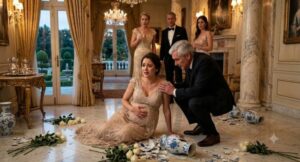
Then my knees struck the marble floor.
I folded both arms around my stomach before I even understood that I was falling.
At twenty-eight weeks pregnant, protecting the baby had become instinct. I covered the curve of my belly and turned slightly, trying to keep my side away from Celeste.
She stood above me in a pale gold dress, breathing hard.
A few drops of champagne trembled along the rim of her glass.
Her other hand was raised.
“Please,” I said. My voice sounded smaller than I expected. “Don’t come near the baby.”
Celeste’s face tightened.
“You always do this,” she said. “You turn everything into a performance.”
The room remained silent.
There were at least fifteen people nearby. Members of Julian’s family. Business partners. Friends who had attended every birthday dinner, holiday party, and charity auction held at Briarwood House.
Not one of them stepped forward.
Some looked uncomfortable.
Others looked curious.
A few simply looked away.
My cheek burned. The pain was not terrible, but the shock of it made my ears ring. The broken vase lay beside me in blue-and-white pieces, its water spreading across the marble beneath a scatter of white roses.
The flowers had been arranged that morning.
I knew because I had arranged them.
Celeste lifted her chin.
“You need to learn when to stop talking.”
Footsteps sounded in the hallway.
Heavy. Fast. Familiar.
My father entered the room.
He had arrived less than ten minutes earlier, according to the message he had sent me. I had not known whether Julian would allow him through the front gates. Dad and Julian had barely spoken in six months.
For a moment, my father did not seem to understand what he was seeing.
His eyes moved from the shattered vase to my position on the floor.
Then he saw the mark on my face.
Something changed in him.
It was not rage, at least not the kind that showed itself through shouting or wild movement. His expression became still. His shoulders lowered slightly. His gaze sharpened.
Julian stepped between us.
My husband had been standing near the fireplace throughout the argument. He had not touched me. He had also done nothing to stop his sister.
Now he adjusted the cuff of his black dinner jacket as if this were an inconvenience he intended to manage.
“This is a private family matter,” he said.
Dad looked at him.
Julian gave a thin smile.
“You should leave, Martin.”
Dad did not answer.
He stepped around Julian and crossed the broken glass.
The soles of his old brown shoes crunched over the fragments. He crouched beside me carefully, keeping one hand near my shoulder without touching me until I nodded.
“Elena,” he said. “Can you stand?”
“I think so.”
“Any pain here?”
His hand hovered near my stomach.
“No. I don’t think so.”
“Dizziness?”
“A little.”
“Did you hit your head?”
“No.”
His voice remained calm.
“Look at me.”
I looked into his gray eyes.
“Can you breathe normally?”
“Yes.”
“Is the baby moving?”
I waited.
My hands shook against my dress.
Then I felt a small push from inside, followed by another.
“Yes.”
Dad closed his eyes for half a second.
When he opened them, he placed one arm behind my back and the other beneath my knees.
“I can walk,” I whispered.
“I know.”
He lifted me anyway.
I had not been carried by my father since I was a child. He was sixty-three now, with silver hair and a bad left knee that bothered him during cold weather. Yet he raised me without hesitation and turned toward the doorway.
Julian blocked his path.
“You are not taking my wife anywhere.”
Dad looked over my shoulder.
“Who touched my daughter?”
No one spoke.
I could hear the soft splash of water still dripping from the edge of the marble onto the carpet.
Celeste laughed.
It was not a natural laugh. It was too bright and too quick.
“She needed correction.”
Dad’s face did not move.
Celeste raised her champagne glass slightly.
“I reminded her how things work in this house.”
My father stared at her.
Celeste’s smile widened, encouraged by his silence.
“She has been acting like an untrained pet since she arrived. Someone had to teach her obedience.”
A murmur passed through the guests.
Perhaps Celeste heard how ugly the words sounded once they were spoken aloud. Her confidence flickered.
Julian stepped closer.
“My sister lost her temper,” he said. “Elena provoked her. We will handle it.”
Dad looked at him for several seconds.
“No,” he said. “You won’t.”
He walked forward.
Julian did not move at first.
Dad kept going.
At the last moment, Julian stepped aside.
The guests separated as my father carried me through the hallway, past the enormous staircase and the portraits of Julian’s ancestors.
Most of the faces in those portraits wore the same expression Julian wore now.
Cold.
Certain.
Untouchable.
Outside, the afternoon sunlight felt too bright.
The garden party had been arranged across the south lawn. White tents covered rows of tables. The quartet sat beneath an arch of ivy. Guests who had not witnessed the scene inside turned as Dad carried me down the front steps.
The music stopped at last.
Near the circular drive, my father’s dark SUV waited beside a line of luxury cars.
He opened the rear door and helped me inside.
“Stay here,” he said.
“Dad—”
“Lock the doors after I close this one.”
“What are you doing?”
“Calling an ambulance.”
“There are phones inside.”
“I’m not going inside.”
Something in his voice made me obey.
He closed the door.
I pressed the lock button.
Through the tinted window, I watched him walk to the rear of the SUV.
Julian came down the steps with Celeste behind him. His mother, Beatrice, followed at a slower pace, one hand resting against the string of pearls at her throat.
“You are making a spectacle of this,” Julian called.
Dad ignored him.
He opened the back of the vehicle, lifted the carpeted floor panel, and pressed his thumb against a small black square built into the metal beneath it.
A narrow compartment clicked open.
Inside was a device that looked like a thick tablet enclosed in a dark protective case.
I had never seen it before.
My father placed the device on the back bumper and opened it.
A blue screen appeared.
Julian stopped walking.
The color left his face so quickly that I almost thought the sunlight had changed.
Celeste lowered her glass.
My father typed a sequence into the terminal. A camera near the top scanned his eyes.
A line of text appeared.
IDENTITY CONFIRMED.
Dad touched a symbol on the screen.
An unmarked black vehicle turned into the estate driveway.
It moved quietly, passing the stone pillars and slowing near the gatehouse. Instead of parking, it stopped sideways across the drive, blocking the only exit.
Two more vehicles appeared behind it.
The guests began talking at once.
Julian looked toward the gate, then back at my father.
“What is this?”
Dad pressed the communication button on the terminal.
“This is Director Hale,” he said. “Code Black authorization on Briarwood target group. Primary asset secured. Begin containment.”
The laughter vanished from Julian’s face.
For most of my life, I had believed my father worked in transportation security.
That was the explanation he gave neighbors, teachers, and curious relatives.
He traveled often.
He knew how to fix broken radios, identify unfamiliar cars from a distance, and tell whether someone had entered a room by studying the position of the furniture.
Whenever I asked for details about his job, he said it was mostly paperwork.
Standing behind the locked door of his SUV, one hand pressed to my stomach, I understood that my father had lied to me.
But it was not the lie that frightened me most.
It was Julian’s reaction.
My husband knew exactly what the terminal meant.
Two emergency medical technicians arrived first.
They entered through the estate gates with a police escort and came directly to the SUV. Dad stepped back while they examined me.
My blood pressure was high. My cheek was swollen, but there were no cuts. The baby’s heartbeat sounded steady through the portable monitor.
Still, the paramedics insisted on taking me to the hospital.
Dad climbed into the ambulance with me.
Through the rear window, I watched the estate disappear.
Men and women in plain dark jackets were moving across the lawn. Guests had been asked to remain under the tents. Several carried phones, but the devices appeared to have stopped working.
Julian stood beside the fountain.
He looked smaller from a distance.
Celeste was speaking rapidly to an officer who did not seem impressed.
Beatrice remained on the front steps, straight-backed and silent.
The ambulance doors closed.
I turned to my father.
“Who are you?”
He looked at the floor.
For the first time that afternoon, he seemed tired.
“My name is still Martin Hale.”
“That isn’t what I asked.”
“I know.”
The paramedic adjusted the monitor around my stomach.
Dad waited until she moved toward the front of the ambulance.
“I work for a federal security directorate,” he said quietly. “We investigate financial networks connected to organized influence, illegal technology transfers, and threats against protected infrastructure.”
I stared at him.
“That sounds like something from a television show.”
“I wish it were.”
“Are you a spy?”
“No.”
The answer came too quickly.
I almost laughed, but nothing felt funny.
“You opened a hidden machine in your car and surrounded my house with black vehicles.”
“It isn’t your house.”
The words landed harder than he intended.
His expression softened.
“I’m sorry.”
“No. You’re right. Julian reminded me often enough.”
“Elena—”
“How long have you known?”
“Known what?”
“That something was wrong with them.”
Dad glanced toward the paramedic.
“Several years.”
My fingers tightened around the edge of the hospital blanket.
“You let me marry him.”
“I didn’t know enough then.”
“You knew something.”
“I knew Julian’s family had connections to people under investigation. That did not mean Julian was involved. Your relationship began before the first serious evidence reached my office.”
“You investigated my husband?”
“I was removed from direct oversight the moment your engagement became serious.”
“But you still knew.”
“Yes.”
“And you didn’t tell me?”
“I warned you.”
“You said you didn’t trust him.”
“I said his family’s financial history was unclear.”
“You told me rich families often hide their debts. I thought you meant they were embarrassed about money.”
“I could not reveal a classified investigation.”
“I was your daughter.”
“You were also emotionally involved with a potential subject.”
I pulled my hand away from his.
The monitor continued its steady rhythm.
My baby’s heartbeat filled the ambulance.
Fast. Strong. Innocent.
Dad leaned forward.
“I should have found a better way. I know that.”
“You stopped speaking to me.”
“You asked me to stop questioning your marriage.”
“Because every conversation became an interrogation.”
“I was trying to understand whether you were safe.”
“And when I said I was, you didn’t believe me.”
His face tightened.
“Were you?”
I looked away.
The ambulance turned onto a wider road.
For months, I had told everyone I was safe.
I told my father.
I told my college friend Nora when she noticed that I had stopped attending our monthly lunches.
I told my obstetrician that the tension at home was normal adjustment.
I told myself that Julian was under pressure because of the family company.
I repeated the word safe so often that it lost its meaning.
Celeste had never struck me before that day.
She did not need to.
At Briarwood, pain was usually delivered through smaller things.
A missing key.
A canceled appointment.
A bank card that suddenly stopped working.
A meal served after I had gone to bed hungry.
A joke made loudly enough for servants to hear.
A door that would not open from the inside.
Julian never shouted.
He did not have to.
When he was angry, he became polite.
That was worse.
“Mrs. Mercer?” the paramedic asked. “Are you experiencing pain?”
“No.”
“Any tightening?”
I focused on my stomach.
“No.”
“Good. We’re almost there.”
Mrs. Mercer.
The name felt like part of a costume.
Three years earlier, I had been Elena Hale, an illustrator who rented a bright second-floor apartment above a bakery. I spent mornings drawing educational comics for children and afternoons working with independent publishers.
I owned mismatched furniture.
I forgot to water plants.
I ate cereal for dinner when deadlines became difficult.
Then Julian Mercer entered the bookstore where I was signing copies of a graphic novel I had illustrated.
He bought three copies.
One for his niece.
One for a friend’s child.
One, he said, for himself.
“You made science look friendly,” he told me.
He wore a navy suit and no tie. His smile was calm. He asked thoughtful questions about my work and did not mention his family’s money until our fourth date.
By then, I already liked him.
That was how Briarwood began.
Not with iron gates.
With coffee.
With books.
With a man who remembered that I disliked cinnamon.
The hospital kept me overnight.
The baby remained stable, but my doctor wanted observation because of the fall and my elevated blood pressure.
Dad stayed in the room until nearly midnight.
He sat in the chair near the window, answering messages on a plain phone that one of his agents had delivered. Every few minutes, someone called. He spoke in short phrases and never used names.
“Hold all transfers.”
“Separate interviews.”
“No external contact until counsel arrives.”
“Preserve the house systems.”
Once, he stepped into the hallway and returned looking grim.
“What happened?” I asked.
“Nothing you need to worry about tonight.”
“That phrase has caused enough trouble in my life.”
He closed the door.
“You’re right.”
“Tell me.”
He hesitated.
“Julian attempted to access a secure server after you left.”
“What server?”
“We don’t know yet.”
“From the house?”
“Yes.”
“Was it illegal?”
“The access method was.”
I leaned back against the pillow.
“Is he under arrest?”
“No.”
“Why not?”
“Containment is not arrest. The people at Briarwood are being questioned while the property is searched under an emergency warrant.”
“How did you get a warrant that quickly?”
“We already had one prepared.”
I stared at him.
Dad looked down.
“That means you expected something.”
“We knew a major transfer was planned from the estate this weekend.”
“What kind of transfer?”
“Digital files.”
“The party was a cover?”
“Possibly.”
I thought about the guests.
There had been executives, local officials, a retired judge, two foreign investors, and several people I recognized from newspaper photographs.
Celeste had organized the event as a charity reception for maternal health clinics.
The irony felt cruel.
“Did you come because of the investigation?” I asked.
“No. I came because you called me yesterday.”
“I didn’t call you.”
“You did.”
“I left a voicemail and hung up.”
“You said my name.”
“I thought the call didn’t connect.”
“It connected.”
I remembered standing in the upstairs bathroom, the only room where I sometimes had privacy.
I had dialed Dad’s number after discovering that Julian had canceled my prenatal appointment without telling me. When my father answered, fear closed my throat.
I whispered, “Dad?”
Then I ended the call.
“I didn’t say I was in danger.”
“You didn’t need to.”
“You had agents nearby?”
“Yes.”
“For how long?”
“Since your first month at Briarwood.”
Anger rose through the confusion.
“You watched me for two years?”
“Not inside the house. We monitored external risks connected to the investigation.”
“Did you read my messages?”
“No.”
“Listen to my calls?”
“No.”
“Follow me?”
“Sometimes.”
I turned toward the window.
The city lights blurred.
“That should make me feel protected.”
“I know it doesn’t.”
“It makes me feel as if everyone knew my life except me.”
Dad stood.
“Elena, I cannot undo what happened. I can tell you the truth from this moment forward.”
“All of it?”
“As much as I legally can.”
“That is not all of it.”
“No.”
At least he was honest.
There was a knock at the door.
Nora entered carrying a paper bag, a phone charger, and the expression of someone prepared to fight an entire hospital.
She was short, broad-shouldered, and still wearing the green veterinary scrubs from her clinic.
When she saw my face, her eyes filled with tears.
Then she noticed my father.
“Mr. Hale.”
“Nora.”
She set down the bag and hugged me carefully.
“I brought your toothbrush, clean clothes, and those crackers you like.”
“Thank you.”
“I also brought your old apartment key.”
I pulled back.
“What?”
“The apartment above the bakery.”
“I gave it up.”
“I didn’t.”
She looked embarrassed.
“When you moved to Briarwood, the landlord asked whether I knew anyone who wanted the place. I took over the lease. I use it as an art studio and storage room.”
“You have an art studio?”
“I have a room filled with your boxes because your husband said there wasn’t space for them.”
Dad looked at me.
I avoided his gaze.
Nora sat beside the bed.
“You can stay there.”
“I don’t even have clothes.”
“You have boxes.”
“I’m seven months pregnant. Nothing in those boxes will fit.”
“We’ll buy clothes.”
“I don’t have access to my bank account.”
Nora went still.
Dad stopped typing.
I immediately regretted saying it aloud.
Nora lowered her voice.
“What do you mean?”
“Julian handles the accounts.”
“You still have your illustration income.”
“It goes into the household account.”
“The account you cannot access?”
“I have a card.”
“Does it work?”
“Usually.”
“Usually?”
I picked at the blanket.
“Julian sets spending limits.”
Nora looked at Dad.
Dad’s expression had become dangerously calm again.
“When did this begin?” he asked.
“It wasn’t like that at first.”
“When?”
“After the wedding.”
Nora’s mouth tightened.
I continued before either of them could speak.
“He said the accountants needed everything organized. Then he said freelance income created tax problems. After I became pregnant, he suggested I stop working for a while.”
“Suggested?” Nora asked.
“He spoke to my publisher.”
“What did he tell them?”
“That the pregnancy was difficult and I needed complete rest.”
“Was it difficult?”
“No.”
Dad closed the phone case.
“Did you authorize him to contact them?”
“No.”
The room became quiet.
I had spent months treating each incident as separate.
The canceled projects.
The blocked cards.
The driver who reported my movements to Beatrice.
The staff members who entered my room without knocking.
The locked gate.
Placed side by side, they formed something I could no longer pretend not to see.
Nora touched my hand.
“You are not going back.”
“I don’t know what I’m doing.”
“You don’t have to know tonight.”
The baby shifted beneath my ribs.
I placed my palm over the movement.
Dad stepped toward the door.
“I’ll arrange security for the apartment.”
“No,” I said.
He stopped.
“I don’t want agents outside my window.”
“Elena—”
“I have spent two years in a house where every door was watched. I cannot move into another guarded room.”
“You remain connected to an active investigation.”
“I never chose that.”
“I understand.”
“No, you understand threats and targets. I need you to understand me.”
He waited.
I took a breath.
“I need choices.”
His eyes softened.
“All right.”
“No agents inside the building. No cameras. No one following me without telling me.”
“I cannot promise there will be no protection.”
“Then tell me what you can promise.”
He considered this.
“One vehicle at a distance. You will have the driver’s name and number. No interior surveillance. No monitoring of personal communication. You may dismiss the detail after seventy-two hours if the immediate threat assessment is clear.”
“That sounds like a contract.”
“It is the best way I know how to make a promise.”
Nora squeezed my hand.
I nodded.
“Seventy-two hours.”
Dad inclined his head.
“Agreed.”
Before leaving, he turned back.
“Your husband has requested permission to speak with you.”
“No.”
The answer surprised me with its certainty.
Dad nodded once.
“I’ll tell him.”
The apartment above the bakery smelled like dust, old paper, and warm bread.
It was the best place I had ever smelled.
Nora had kept the yellow sofa I sold her when I moved away. My old drawing table stood near the front window beneath a covering sheet. Boxes filled the hallway and half the bedroom.
The apartment was small enough that I could hear the bakery mixers begin each morning at four.
On my first night there, I slept for ten hours.
When I woke, sunlight stretched across the wooden floor.
For several seconds, I did not know where I was.
Then I noticed the water stain on the ceiling shaped like a rabbit.
Home.
The word appeared before I could stop it.
My phone was gone. The device I had used at Briarwood belonged to the Mercer family account and had been taken as evidence.
Dad provided a replacement.
I left it turned off for most of the first day.
Nora helped me sort the boxes. We found maternity leggings, oversized sweaters, my grandmother’s quilt, and six sketchbooks I thought had been lost.
At the bottom of one box was the framed illustration from my first published book.
It showed a small fox standing before a dark forest with a paper lantern in its paw.
The title had been The Light You Carry.
I stared at it until Nora sat beside me.
“You stopped drawing foxes,” she said.
“I stopped drawing everything.”
“You can start again.”
“I don’t know if I remember how.”
“Your hand remembers.”
I opened one of the sketchbooks.
The last completed page was dated two weeks before my wedding.
Beneath it, several pages had been torn out.
“Did you do that?” Nora asked.
“No.”
She leaned closer.
There were faint marks where someone had pressed against the removed pages.
Writing.
Numbers.
A diagram.
Nora found a pencil in a jar. I shaded lightly across the next page, revealing the impressions left behind.
A series of boxes appeared.
Arrows.
Initials.
Dates.
At the bottom, one phrase became visible.
Hale clearance connection?
My stomach tightened.
“Julian,” I whispered.
Nora looked at me.
“This was stored at Briarwood?”
“Yes.”
“Why would he write in your sketchbook?”
“He used to borrow them during meetings. He said drawing helped him think.”
“Did you ever see what he drew?”
“No. He usually tore the pages out.”
Nora took a photograph with her phone.
“We should send this to your father.”
I almost refused.
I was tired of the investigation entering every part of my life.
Then I looked at the words again.
Hale clearance connection.
My father had not merely suspected Julian because of his family.
Julian may have approached me because of Dad.
The room seemed to tilt.
I sat down.
Nora called him.
Dad arrived twenty minutes later with a woman named Agent Priya Shah. She wore jeans, a gray coat, and no visible badge until she showed it to me.
She photographed the sketchbook, sealed it in a clear evidence sleeve, and asked where I had found it.
Dad stood near the window.
He did not speak.
When Priya finished, I turned to him.
“Did Julian know what you did before we met?”
“We believed he did not.”
“That is not what I asked.”
Dad exhaled slowly.
“We now have evidence that he may have known.”
“How?”
“One of the files recovered at Briarwood contained a partial personnel chart. My name was on it.”
“What does that mean?”
“It means someone accessed restricted information.”
“And Julian married me to get to you?”
“We don’t know.”
I laughed once.
The sound was hollow.
“You keep saying that.”
“Because I will not replace facts with guesses.”
“Then give me the facts.”
Priya glanced at Dad.
He nodded.
She sat across from me.
“Mercer Strategic Holdings has been under investigation for three years,” she said. “The company officially manages infrastructure projects, private security contracts, and data systems. Several subsidiaries appear to have transferred restricted technology through international shell companies.”
“And Julian?”
“He supervised legal compliance.”
“That sounds legitimate.”
“It should have been.”
“But it wasn’t.”
“We recovered internal communication showing he approved access routes later used for unauthorized transfers.”
I looked at my father.
“You knew this before the wedding?”
“No,” he said. “The messages were encrypted. We accessed them yesterday.”
Priya continued.
“Your marriage may have provided the Mercer family with social protection. Director Hale’s daughter entering the family created the appearance that the Mercers had passed a level of scrutiny.”
“So I was decoration.”
“We do not know Julian’s personal intentions.”
I stood too quickly.
The baby pressed downward, and I caught the edge of the table.
Nora rose beside me.
“I’m fine.”
Dad moved forward, then stopped himself.
I walked to the window.
Below, customers entered the bakery. A mother held the hand of a little boy wearing a red backpack. A delivery driver stacked flour bags near the side door.
Ordinary life continued.
“Was the baby part of it?” I asked.
No one answered.
I turned around.
“Did he want a child because it made the marriage look permanent?”
Dad’s face showed pain.
“Elena.”
“I need to know.”
Priya spoke carefully.
“We found no communication referring to your pregnancy as part of an operation.”
That was not comforting.
It only meant the cruelty might have been personal.
“What happens now?” I asked.
“The estate remains sealed,” Priya said. “Several people have been detained for questioning. Julian has not been formally charged, but his travel is restricted.”
“And Celeste?”
“She may face charges related to the incident and evidence found on her devices.”
“What evidence?”
Dad answered.
“Messages about you.”
My mouth went dry.
“What kind of messages?”
He looked toward Priya.
She gave a small nod.
Dad took a printed sheet from his coat.
“You don’t have to read this now.”
“Give it to me.”
He handed it over.
The first message was from Celeste to Beatrice.
She’s becoming suspicious about the accounts.
The reply came five minutes later.
Then keep her occupied.
Another message:
She tried to leave for an appointment alone.
Beatrice replied:
The gate staff have instructions.
A third exchange was between Celeste and Julian.
Your wife called her father.
Julian:
How long?
Celeste:
Less than ten seconds.
Julian:
Watch her more closely.
My hands began trembling.
Nora took the paper before I dropped it.
Dad’s voice remained soft.
“I’m sorry.”
“Did they talk about my work?”
“Yes.”
“My friends?”
“Yes.”
“My medical appointments?”
“Yes.”
“Did Julian know Celeste was going to confront me at the party?”
“We don’t know.”
I looked at the shaded impression in the sketchbook.
For the first time since leaving Briarwood, I felt something stronger than fear.
Anger.
Not the wild anger I had seen in Celeste.
Mine was quieter.
It settled into the empty places where excuses had been.
“I want my own lawyer,” I said.
Dad nodded.
“I can arrange—”
“Not someone from your agency.”
“All right.”
“And not anyone connected to the Mercers.”
“Of course.”
“I want copies of every financial record with my name on it. I want to know where my earnings went. I want medical records showing who canceled my appointments. I want everything.”
Priya closed her notebook.
“We can help obtain records through proper channels.”
“I also want to speak to Julian.”
Dad’s eyes narrowed.
“No.”
“You said I had choices.”
“You do. That does not mean every choice is safe.”
“I will not meet him alone.”
“What do you hope to gain?”
“The truth.”
“He may lie.”
“Then I want to hear how he lies.”
Dad studied me.
Priya spoke before he could answer.
“A monitored interview may be useful.”
He looked at her.
“She is a civilian.”
“She is also a direct witness.”
“I am standing here,” I said.
Dad closed his eyes briefly.
When he opened them, he looked at me rather than Priya.
“You decide,” he said.
The interview took place in a federal office building two days later.
It was not an interrogation room.
There was a round table, four chairs, a window that did not open, and a painting of a river hung slightly crooked on the wall.
My lawyer, Lydia Grant, sat to my right.
She was in her forties, with closely cropped hair and a calm voice. Nora found her through a legal support network for financial control cases.
Dad watched from another room.
Julian entered with his attorney.
He wore a charcoal suit and looked as though he had slept poorly. There was a faint shadow along his jaw. His hair, usually perfect, fell across his forehead.
For one dangerous instant, he looked like the man from the bookstore.
The man who bought three copies of my book.
The man who left coffee outside my apartment when I was sick.
The man who once drove four hours because I mentioned missing a lake from my childhood.
Then he sat down and placed his hands on the table.
His wedding ring was still on.
“Elena.”
I said nothing.
His attorney began.
“My client agreed to this conversation because he is concerned for his wife and unborn child. He does not waive any legal rights or admit wrongdoing.”
Lydia nodded.
“My client is here voluntarily and may end the meeting at any time.”
Julian looked at my cheek.
The swelling had faded into a pale bruise.
“I am sorry about what Celeste did.”
“Did you know she was going to do it?”
“No.”
“Did you see her raise her hand the first time?”
His gaze shifted.
“There was confusion.”
“There were fifteen people in the room.”
“She moved quickly.”
“Did you see me fall?”
“Yes.”
“Did you help me?”
“My father-in-law entered almost immediately.”
“That was not my question.”
Julian pressed his lips together.
“No.”
“Why?”
“I was shocked.”
“You told my father he could not take me.”
“I did not know whether moving you was medically safe.”
“You are not a doctor.”
“Neither is he.”
“He called an ambulance.”
“I would have done the same.”
“But you didn’t.”
His attorney leaned toward him, but Julian continued.
“I made mistakes.”
“Did you cancel my prenatal appointment?”
“I rescheduled it.”
“You did not tell me.”
“You had an event.”
“Celeste had an event. I was expected to decorate the rooms.”
“You were tired.”
“I wanted to see my doctor.”
“You saw her the previous month.”
I felt Lydia’s hand rest near my arm, not touching, simply reminding me she was there.
“Did you contact my publisher?” I asked.
“Yes.”
“Why?”
“You needed rest.”
“Did my doctor tell you that?”
“No.”
“Did I?”
“No.”
“Then who decided I needed rest?”
Julian’s composure weakened.
“I saw what the deadlines were doing to you.”
“I loved my work.”
“You complained about it.”
“Everyone complains about work.”
“You stayed awake all night.”
“Twice. In four years.”
“You were carrying my child.”
“Our child.”
He looked away.
I continued.
“Why did my income go into an account I could not access?”
“You could access it.”
“With limits you controlled.”
“We had security concerns.”
“What concerns?”
“Your father’s position.”
“So you knew what he did.”
Silence.
His attorney whispered something.
Julian shook his head.
“I knew he worked in government security.”
“You wrote ‘Hale clearance connection’ in my sketchbook before we married.”
His face changed.
It was small.
A tightening around the eyes.
But I saw it.
The bookstore smile disappeared.
His attorney sat straighter.
Julian folded his hands.
“I don’t remember writing that.”
“You tore out the page.”
“I used many notebooks.”
“My notebooks.”
“You gave me permission.”
“To draw. Not to investigate my father.”
“I was not investigating him.”
“What were you doing?”
He looked directly at me.
“Protecting my family.”
The sentence entered the room and stayed there.
I waited.
Julian glanced at his attorney.
The attorney said, “We should end this meeting.”
“No,” Julian replied.
“Mr. Mercer—”
“She deserves an explanation.”
I almost laughed.
He still believed he decided what I deserved.
Julian leaned back.
“When we met, I knew your father had authority within a federal security division. I did not know his exact role.”
“So meeting me was planned.”
“No.”
“Was it?”
“No. I went to the bookstore because my niece liked your work.”
“You don’t have a niece.”
His face went still.
Celeste had no children.
Julian’s older brother died unmarried at twenty-four.
There was no niece.
“I meant a cousin’s daughter.”
“You said niece for three years.”
“It was simpler.”
“Was the friend’s child real?”
“Yes.”
“And the third copy?”
He said nothing.
The memory returned with painful clarity.
One for my niece.
One for a friend’s child.
One for myself.
Three books.
Three reasons.
One lie.
“You knew who I was before you entered the store,” I said.
Julian looked at the table.
“Yes.”
Lydia shifted beside me.
My chest felt tight, but my voice remained steady.
“Why?”
“At first, I wanted to understand whether your father was involved in the investigation.”
“At first.”
“I liked you.”
“That does not answer me.”
“I fell in love with you.”
“You watched me before speaking to me.”
“I read interviews about your work. I attended a public event. That is not watching.”
“You used me.”
“No.”
“You married me while collecting information about my father.”
“I stopped.”
“When?”
“Before the wedding.”
“Then why did you monitor my calls?”
“I did not personally monitor them.”
I stared at him.
He heard the words only after speaking.
His attorney closed his eyes.
“Who did?” I asked.
“Elena—”
“Who monitored my calls?”
“The house security system records communications made through the internal network.”
“Who checked those records?”
“Celeste sometimes reviewed them.”
“On whose authority?”
He did not answer.
“Yours?”
His silence was enough.
My baby moved.
I placed one hand against my side.
Julian’s gaze dropped toward my stomach.
His expression softened.
It might have been real.
That was the worst part.
People wanted cruelty to be simple. They wanted a villain to feel nothing, so leaving could feel clean.
Julian felt things.
He had made soup when I was ill.
He had once sat on the bathroom floor with me through a night of morning sickness.
He spoke to the baby when he believed I was asleep.
He had also watched his family close the gates around me.
Both truths existed.
“Did you marry me because of my father?” I asked.
“No.”
“Would you have approached me if I were someone else’s daughter?”
He looked at me for a long time.
“I don’t know.”
The answer hurt more than a lie.
I stood.
Julian rose too.
“Elena, please.”
Lydia moved between us.
Julian stopped.
“I can fix this,” he said.
I looked at him.
“The house? The accounts? Your sister?”
“Our marriage.”
“You still think the marriage is the broken part.”
“What else is there?”
“Me.”
His face tightened.
“You can’t fix me because I am not yours to repair.”
“I didn’t say you were.”
“You did. Every day. In quieter words.”
He lowered his voice.
“I love you.”
“I believe you.”
Hope appeared in his eyes.
Then I finished.
“I also believe you love control more.”
I left the room.
The investigation spread across the news within a week.
Mercer Strategic Holdings announced that Julian had taken temporary leave.
Beatrice released a statement denying all misconduct.
Celeste’s attorney described the incident at Briarwood as “an unfortunate private disagreement.”
No one used my name because Lydia obtained a temporary privacy order.
The public still found pieces of the story.
Photographs of the blocked estate gates appeared online. Commentators speculated about government contracts and hidden servers.
A former employee claimed the company had transferred surveillance software through a chain of consulting firms.
Two executives resigned.
Three foreign accounts were frozen.
At the apartment, I began drawing again.
At first, I drew simple things.
The bakery sign.
Nora’s coffee mug.
My swollen feet.
The small row of baby clothes hanging beside the radiator.
Then I started sketching a woman standing in a house with too many doors.
Every door had a different lock.
Some were made of brass.
Some were made of glass.
Some looked open until she tried to pass through them.
The woman carried a lantern.
I did not intend to turn it into a story.
It became one anyway.
Dad visited every evening but never entered without knocking.
Sometimes he brought groceries. Sometimes he sat at the small kitchen table and answered questions.
I learned that my mother, who died when I was eleven, had known about his work. Their marriage had included rules, emergency plans, and long separations.
“Did she ever ask you to quit?” I asked.
“Several times.”
“Why didn’t you?”
“I believed the work mattered.”
“Did it matter more than she did?”
He considered the question instead of defending himself.
“Sometimes I behaved as if it did.”
“Did she forgive you?”
“Some things. Not all.”
I shaded the edge of my drawing.
“Why didn’t you tell me after she died?”
“You were a child.”
“I stopped being a child.”
“I kept waiting for a safe time.”
“There wasn’t one.”
“No.”
The bakery mixers rumbled beneath us.
Dad looked at the growing stack of drawings.
“Your mother kept every book you illustrated.”
“I only published two before she died.”
“She kept the newspaper clipping from your school art competition.”
“I came third.”
“She said the judges lacked vision.”
I smiled despite myself.
Dad smiled too.
It was the first easy moment between us in months.
Then his expression grew serious.
“We recovered your financial records.”
I set down the pencil.
“How bad?”
“Your freelance income was transferred into a Mercer family management account. Some of it paid household expenses. A significant portion was invested without your authorization.”
“Lost?”
“No. The investments increased in value.”
I did not know whether to laugh or cry.
“So they stole my money successfully.”
“That is one interpretation.”
“It is the correct interpretation.”
“Yes.”
“How much?”
He told me.
The amount was larger than I expected.
Years of work had not disappeared.
It had been absorbed.
Renamed.
Controlled.
“Can I get it back?”
“Lydia believes so.”
“What about the house?”
“Briarwood is owned through a family trust.”
“I don’t want it.”
“You may have marital property claims.”
“I don’t want a room in that place.”
“I understand.”
“What about Julian?”
Dad’s jaw tightened.
“What about him?”
“Has he been charged?”
“Not yet.”
“Do you think he will be?”
“Yes.”
“For the technology transfers?”
“For several matters.”
“Will you decide that?”
“No. I have removed myself from all charging decisions connected to him.”
“Because of me?”
“Because impartiality matters.”
I looked at him.
“That must be difficult.”
“It is.”
“Do you want to destroy him?”
Dad was silent for several seconds.
“I want the law applied to him.”
“That is not what I asked.”
He looked toward the window.
“Yes.”
The honesty surprised me.
“But wanting something,” he added, “does not give me the right to do it.”
I thought of Julian.
Wanting control had been enough for him.
The difference between the two men was not that one possessed power and the other did not.
It was what they believed power permitted.
Celeste requested a meeting.
Her lawyer contacted Lydia and claimed Celeste possessed information relevant to my financial case. In exchange, she wanted me to provide a statement asking prosecutors for leniency regarding the incident at the party.
My first response was no.
Then Lydia explained that the decision was mine, but hearing the offer did not require accepting it.
We met in a private conference room at Lydia’s office.
Celeste arrived without champagne, jewelry, or the armor of Briarwood.
She wore a plain cream sweater and dark trousers. Her hair was pulled into a low knot.
A faint bruise marked the skin beneath one eye.
I noticed it immediately.
She saw me notice.
“I walked into a cabinet,” she said.
I did not believe her.
Neither did Lydia.
Celeste sat across from me.
Her lawyer began speaking, but she interrupted.
“I want to talk to Elena alone.”
“No,” Lydia and the other lawyer said together.
Celeste gave a tired laugh.
“Fine.”
She folded her hands.
“I know where Julian hid the original account authorizations.”
Lydia leaned forward.
“What authorizations?”
“The documents used to move Elena’s income into the family fund. The copies recovered from the estate show her electronic signature.”
“I never signed them,” I said.
“I know.”
“Did you forge it?”
“No.”
“Who did?”
“Julian.”
The answer did not surprise me, yet hearing it still hurt.
Celeste looked at my stomach.
“How is the baby?”
“Do not ask me that.”
She nodded.
“All right.”
“Why are you helping me?”
“I need you to tell the court that what happened was an argument. Not an attack.”
“You drove me onto the floor.”
Her face tightened.
“I lost control.”
“You raised your hand again.”
“I was angry.”
“So was I. I did not touch you.”
“You humiliated me.”
“I told you the charity invoices did not match the deliveries.”
“In front of the staff.”
“Because you ordered me to approve them in front of the staff.”
Celeste’s lawyer touched her arm.
She pulled away.
“You always acted innocent,” Celeste said. “You came into our home pretending you did not care about the money. You made Julian question everything.”
“What did I make him question?”
“His obligations.”
“To whom?”
“To the family.”
I stared at her.
“He monitored my calls, controlled my accounts, interfered with my work, and prevented me from leaving the estate.”
“He was protecting you.”
“From what?”
She opened her mouth.
Nothing came out.
I leaned forward.
“Did you know why he approached me?”
Celeste looked at the table.
“Yes.”
“Before we married?”
“Yes.”
“Did Beatrice know?”
“Yes.”
“Was I discussed as part of company strategy?”
Celeste closed her eyes.
Her lawyer whispered, “You do not need to answer.”
“Yes,” she said.
The room became very quiet.
“What was the strategy?” I asked.
“Your father’s office was increasing scrutiny on our contracts. Julian believed a personal connection might help us learn how much they knew.”
“Did he report information about me?”
“At first.”
“What information?”
“Where your father traveled. When he called. Names you mentioned.”
“I never knew names.”
“You knew more than you realized.”
My stomach turned.
Casual conversations returned to me.
Julian asking whether Dad still traveled to Brussels.
Whether his department handled airports or ports.
Whether he knew a certain senator.
I had considered it normal curiosity.
“Why did Julian marry me?” I asked.
Celeste’s expression shifted.
“That part changed.”
“How?”
“He was supposed to remain close to you for a few months. Then he fell in love.”
I almost laughed.
“That is his defense?”
“It is the truth.”
“No. It is one truth.”
Celeste looked at me with something close to desperation.
“You don’t understand what the family was like before you arrived.”
“I understand more than you think.”
“Julian obeyed our mother. He never questioned the company. Then he met you and started arguing about transfers, contracts, everything.”
“So this is my fault?”
“I didn’t say that.”
“You called me an animal.”
Her face reddened.
“I wanted you gone.”
“Why?”
“Because he chose you.”
The answer was so simple that it sounded childish.
Perhaps the deepest wounds often did.
Celeste continued.
“My whole life, Julian and I were a unit. Our father died. Our brother died. Our mother held the family together by making us useful. Julian handled the company. I handled the house and public events. Then you arrived, and suddenly he wanted a life that did not include me.”
“That did not give you the right to punish me.”
“I know.”
“Do you?”
She touched the bruise beneath her eye.
I looked at it again.
“Who did that?”
“No one.”
“Was it Julian?”
Her silence answered.
“When?” I asked.
“After the agents left Briarwood. We were released to our attorneys. He blamed me for what happened at the party.”
“You told the press it was a private disagreement.”
“I was advised to.”
“Did he strike you?”
Her lawyer interrupted.
“This is outside the purpose of the meeting.”
Celeste laughed bitterly.
“Everything is outside the purpose until someone needs it hidden.”
She looked at me.
“Yes.”
I sat back.
The room seemed colder.
“Once?” Lydia asked.
Celeste’s eyes remained on mine.
“No.”
I felt no satisfaction.
No sense of justice.
Only a deep exhaustion.
“You treated me the way he treated you,” I said.
Celeste’s mouth trembled.
“Our mother said weakness spreads if you allow it.”
“And you believed her.”
“I had to.”
“No. You chose to.”
Anger flashed in her face.
Then faded.
“You sound like him.”
“Who?”
“My father.”
I had seen portraits of Edmund Mercer throughout Briarwood. He died five years before I met Julian.
Everyone described him as brilliant, disciplined, and demanding.
No one described him as kind.
Celeste reached into her bag.
Her lawyer tried to stop her.
She removed a brass key and placed it on the table.
“There is a private records room beneath the old greenhouse,” she said. “The agents found the electronic archive, but not the paper files. The entrance is behind the irrigation controls.”
Lydia did not touch the key.
“Why was this not disclosed during the search?”
“Because no one asked me.”
“You were questioned for nine hours.”
“No one asked the correct question.”
I looked at her.
“What is inside?”
“Original signatures. Private agreements. Letters from my father. Records my mother kept because she trusted paper more than computers.”
“And my documents?”
“Yes.”
“What do you want from me?”
“A statement that I am seeking treatment and that you do not believe prison is necessary.”
“Are you seeking treatment?”
“I have an appointment next week.”
“Because you want help or because your lawyer told you to?”
She looked away.
“I don’t know yet.”
It was the most truthful thing she had said.
“I will not promise a statement,” I said. “Give the information to Lydia. Cooperate fully. Attend treatment. Stop lying about what happened.”
“And then?”
“Then I will decide what I believe.”
Celeste’s eyes filled, but she did not cry.
She pushed the key toward Lydia.
As she stood to leave, I spoke again.
“Celeste.”
She turned.
“You are not responsible for what Julian did to you.”
Her face hardened.
I continued.
“But you are responsible for what you did to me.”
She nodded once.
“I know.”
This time, I thought she might.
The greenhouse records changed the case.
Investigators found twenty-three boxes beneath a false floor.
The documents showed decades of hidden payments, unauthorized technology sales, and political favors disguised as consulting fees.
My forged signatures were there too.
So were internal instructions regarding my marriage.
One memorandum, written by Beatrice before my engagement, referred to me as a “relational access opportunity.”
Another recommended encouraging the marriage if Julian could “maintain emotional compliance.”
I read the phrase three times.
Emotional compliance.
A clean term for a dirty idea.
The documents also showed that Julian had resisted parts of the plan.
Six months after meeting me, he wrote to Beatrice that no further information should be collected through our relationship.
She responded:
Affection does not remove obligation.
He replied:
This is not open for discussion.
For a while, he had tried to protect me from the same plan that brought him into my life.
Then the company investigation intensified.
His resistance weakened.
He began using my calls, my father’s visits, and my friendships as sources again.
Love had not saved me.
It had merely made his choices more complicated.
Beatrice was arrested first.
Celeste entered a cooperation agreement.
Julian was charged with conspiracy, unlawful access to protected systems, financial fraud, and obstruction.
The news broke on a rainy Thursday morning.
I watched from the apartment as reporters gathered outside Briarwood.
Julian walked down the front steps beside his attorney.
He did not look at the cameras.
For the first time since I knew him, he was not in control of the room.
I expected to feel relieved.
Instead, I cried.
Nora sat with me on the sofa.
She did not tell me to stop.
“I hate that I miss him,” I said.
“You miss parts of him.”
“What if those parts were fake?”
“Some probably were.”
“That is not helpful.”
“The coffee might have been strategy. Remembering your birthday might have been strategy. But people cannot perform every second for three years. Some moments were likely real.”
“That makes it worse.”
“I know.”
I pressed both hands against my face.
“What will I tell the baby?”
“The truth, when the truth is age-appropriate.”
“That his father used me?”
“That his father made serious choices and is responsible for them.”
“What if Julian goes to prison?”
“Then you tell your son where he is.”
“What if he wants to know him?”
Nora looked at me.
“Then you decide what is safe. Not what makes the Mercers comfortable. Not what makes your father comfortable. What is safe for your child.”
I lowered my hands.
The baby kicked.
“He’s going to be a boy,” I said.
“You decided to find out?”
“My doctor accidentally used ‘he’ during the scan.”
Nora smiled.
“Do you have a name?”
“Samuel.”
“After your grandfather?”
“My mother’s father.”
“Have you told your dad?”
“Not yet.”
Dad arrived that evening with takeout noodles.
When I told him the name, he stared at the containers for a long moment.
“Your mother would have liked that,” he said.
“I thought so.”
He cleared his throat.
“I have something for you.”
From his coat, he removed a thin envelope.
Inside was a property deed.
I looked at the address.
It belonged to a small cottage outside the city, near the lake where my mother used to take me.
“What is this?”
“The house was hers.”
“I thought it was sold.”
“She left it to you in trust.”
“You were the trustee?”
“Yes.”
“Why didn’t you tell me?”
“You had access at thirty.”
“I turned thirty last year.”
“I know.”
I looked at him.
Dad’s face showed immediate regret.
“I delayed the transfer because you were married to Julian,” he said. “I feared the property could become connected to his family.”
“You decided for me again.”
“Yes.”
Anger rose.
He did not defend himself.
“I was wrong,” he said.
The direct admission slowed me.
“I believed withholding it protected you. Instead, I repeated the same pattern I condemned in him. I used concern as permission.”
I looked at the deed.
The cottage had two bedrooms, a sloping roof, and a garden my mother once filled with lavender.
“Is it still standing?”
“It needs repairs.”
“How many?”
“A reasonable number.”
“That means many.”
“A few.”
“Does the roof leak?”
“Only during heavy rain.”
“So yes.”
“Yes.”
I smiled despite myself.
Dad slid a second document across the table.
It transferred full control of the trust to me.
“No conditions,” he said. “No security restrictions. No approval required.”
I read every page.
He waited.
“You could live there,” he said. “Or sell it. Or leave it empty. It is yours.”
“Thank you.”
“I should have done this a year ago.”
“Yes.”
He nodded.
“Can you help me repair it?”
His expression softened.
“If you ask me to.”
“I’m asking.”
“Then yes.”
The cottage took six weeks to make livable.
Dad repaired the roof with help from a contractor who complained that federal directors did not know how to hold ladders correctly.
Nora painted the smaller bedroom pale green.
I turned the sunroom into a studio.
Lydia helped me recover my money and file for divorce.
Julian contested almost nothing.
Through his attorney, he transferred the investment accounts into my name and waived claims against my future income.
He requested structured visitation after the baby’s birth, depending on the criminal case.
I did not answer immediately.
The legal proceedings would take months, perhaps years.
My pregnancy would not wait for the courts.
At thirty-four weeks, I returned to the apartment one final time to collect the remaining boxes.
A letter waited beneath the door.
There was no return address.
Inside were four handwritten pages from Julian.
Elena,
My lawyer advised me not to contact you. I am writing anyway, which may prove that I still confuse wanting something with having the right to take it.
I read that sentence twice.
He did not ask forgiveness.
He described the bookstore.
He admitted he had entered knowing my name, my work, and my connection to Dad.
He said the third book truly had been for himself.
He still owned it.
He wrote that he had loved me but built our marriage on a locked foundation. Each time the truth threatened to surface, he added another lock.
He claimed he wanted to protect me from his family.
Then he became the person enforcing their rules.
Near the end, he wrote:
When Celeste hurt you, I saw the whole structure clearly for one second. I saw what we had made you become inside that house—quiet, careful, always checking faces before speaking. I should have moved toward you. Instead, I moved toward control. I thought stopping your father from taking you would stop the truth from leaving with you.
I do not know what will happen to me. I will not ask you to wait. I will not ask you to tell our son that I am better than the record shows.
I ask only that one day, if you believe it is safe, you let me answer his questions myself.
I folded the letter.
Nora watched from across the room.
“Do you want to keep it?” she asked.
“I don’t know.”
“You don’t have to decide.”
I placed it in a box with the legal documents.
Not the memories.
Not the photographs.
The legal documents.
That felt like the correct place.
Samuel Hale was born three weeks early during a storm.
Rain struck the cottage windows throughout the afternoon. I was in the studio drawing when the first contraction came.
I assumed it was another false alarm.
Then my water broke across the floor beside the drawing table.
I stared down at it.
“Oh,” I said.
The baby kicked.
“Apparently we’re doing this.”
Nora drove me to the hospital while Dad followed in another car.
The labor lasted eleven hours.
There was no dramatic emergency.
No team running down hallways.
Only pain, waiting, breathing, ice chips, monitors, and Nora telling me that I was allowed to swear at anyone except the baby.
Dad stayed outside until I asked for him.
When he entered, he looked more frightened than he had at Briarwood.
“Are you all right?” he asked.
“No.”
“What do you need?”
“I have no idea.”
He stood beside the bed.
“Then I’ll stay until you do.”
Samuel arrived shortly after midnight.
He weighed six pounds and had a small crease between his eyebrows that made him look concerned about the state of the world.
When the nurse placed him against my chest, everything else disappeared.
Not forever.
The investigation still existed.
The divorce still existed.
Julian still existed.
But for that moment, there was only the warm weight of my son, his tiny hand opening against my skin.
Dad stood near the wall with tears on his face.
“You can come closer,” I told him.
He approached carefully.
“This is Samuel.”
“I know.”
“No, you don’t. You haven’t met him.”
Dad laughed softly.
“Hello, Samuel.”
The baby opened one eye.
“He looks suspicious of you,” Nora said.
“He has good instincts,” I replied.
Dad touched one finger to Samuel’s hand.
Samuel closed his fist around it.
My father stopped breathing for a second.
I understood then that strength did not always look like standing between someone and danger.
Sometimes it looked like allowing a tiny hand to hold you.
Julian was permitted to see Samuel once before his trial.
The visit took place in a family services center under supervision.
Dad objected.
Lydia asked whether I was certain.
Nora promised to wait in the parking lot.
I went anyway.
Not because Julian deserved comfort.
Because Samuel deserved a mother who made decisions from clarity rather than fear.
Julian entered wearing a plain blue shirt.
Without the tailored suits and Briarwood walls, he looked younger.
More ordinary.
He stopped when he saw the baby.
Samuel was six weeks old, wrapped in a gray blanket.
Julian sat across from me.
“May I hold him?”
The supervisor looked at me.
I nodded.
Julian washed his hands at the sink. When he returned, I showed him how to support Samuel’s neck.
His hands trembled.
I had never seen that before.
“Hello,” he whispered.
Samuel opened his eyes.
Julian smiled, and for a moment I saw the man who spoke to my stomach at night.
The sight hurt.
“He has your mouth,” Julian said.
“He has your serious expression.”
“I’m sorry about that.”
Samuel made a small sound.
Julian looked at me.
“Thank you for bringing him.”
“This is not a promise.”
“I understand.”
“Future contact depends on safety, legal decisions, and your behavior.”
“I understand.”
“You do not contact me directly. Everything goes through Lydia.”
“Yes.”
“You do not send gifts through your family.”
“Yes.”
“Beatrice will have no contact.”
His jaw tightened.
“Yes.”
“Celeste may eventually have limited contact if her treatment continues and I believe it is safe.”
He looked surprised.
“That is your decision,” I said. “Not yours.”
He nodded.
Samuel began fussing.
Julian shifted him carefully.
“You’re good at that,” I said before I could stop myself.
“My brother was ten years younger than me.”
The brother who died.
Julian rarely spoke about him.
“I helped raise him,” he continued. “Before our father decided affection made boys weak.”
Samuel settled.
Julian stared down at him.
“I don’t want him to learn anything from my father.”
“Then you will need to unlearn it yourself.”
“I’m trying.”
“Trying is not proof.”
“No.”
The supervisor announced five minutes remaining.
Julian’s eyes filled.
He did not look away.
“Elena, I know I have no right to ask—”
“Then don’t.”
He closed his mouth.
After a moment, he nodded.
When the visit ended, he returned Samuel to me.
His hand lingered near the blanket but did not touch my arm.
That mattered.
It did not erase anything.
It was simply one correct choice.
Sometimes change began that small.
The trial lasted nine weeks.
I testified for two days.
The courtroom was less impressive than Briarwood’s drawing room. The carpet was worn. The lights hummed. The wooden benches creaked whenever someone shifted.
Beatrice sat at the defense table without her pearls.
Julian sat beside his own attorney.
Celeste testified for the prosecution.
When asked about the marriage strategy, she spoke clearly.
When asked about the party, her voice shook.
“Yes,” she said. “I struck Elena.”
“Why?”
“Because she challenged a false charity account and threatened to contact an outside auditor.”
“Did anyone instruct you to confront her?”
“My mother told me to make sure Elena signed the approval.”
“Did Mr. Mercer know?”
Celeste looked at Julian.
“Yes.”
Julian closed his eyes.
My testimony focused on the accounts, surveillance, canceled appointments, and restrictions at Briarwood.
The defense attorney asked why I had not left earlier.
The question had been expected.
It still felt like an accusation.
“I kept waiting for a moment bad enough to justify leaving,” I said.
“Were you physically prevented from walking out?”
“The gates required authorization.”
“You could have called the police.”
“My calls were monitored.”
“You had contact with your father.”
“I had been taught to believe contacting him would endanger his work and destroy my marriage.”
“But no one held you prisoner.”
Lydia had prepared me for this.
I looked at the jury.
“Not every cage is built from bars. Sometimes it is built from money, embarrassment, pregnancy, controlled transportation, watched communication, and the belief that no one will believe you because the people hurting you are polite in public.”
The courtroom became silent.
The defense attorney changed the subject.
The jury convicted Beatrice on most counts.
Julian was convicted on charges related to financial fraud, unlawful system access, and obstruction. He was acquitted on one count connected to the largest technology transfer because the evidence did not prove he knew the final destination.
He accepted responsibility during sentencing.
The judge imposed a prison term shorter than prosecutors requested but long enough that Samuel would be in school before Julian became eligible for release.
Celeste received probation under strict conditions because of her cooperation, documented treatment, and evidence of coercion within the family.
Her attorney asked me for the statement we had discussed months earlier.
I provided one.
I did not excuse her.
I wrote that accountability and treatment were both necessary, and that I did not believe repeating the family’s pattern of punishment without rehabilitation would protect anyone.
After court, reporters waited near the steps.
Dad’s agents offered to take me through a private exit.
I declined.
I walked out carrying Samuel.
Nora walked beside me.
Dad followed a few steps behind.
Questions came from every direction.
“Mrs. Mercer, do you feel justice was served?”
“Will you allow your husband to see his child?”
“Did your father misuse his authority?”
“Were you involved in the investigation?”
I did not stop.
The flashes reflected against the courthouse windows like white squares in a comic panel.
For years, other people had written my role.
Daughter.
Access opportunity.
Wife.
Asset.
Witness.
Victim.
I was done answering to names chosen by strangers.
At the car, one reporter called, “What will you do now?”
I paused.
Samuel slept against my chest.
“I’m going home,” I said.
This time, I knew exactly where that was.
Two years later, the lavender returned to the cottage garden.
Dad planted too much of it.
He claimed the nursery had delivered the wrong amount, but I found the receipt.
Nora opened her own veterinary clinic in town.
Celeste sent Samuel a birthday card every year through Lydia. The first contained only her name. The second included a drawing of a small dog wearing a party hat.
I kept both cards in a locked box.
Not every locked thing was a prison.
Some locks protected boundaries.
Julian wrote letters from prison.
I read them before deciding whether to store them for Samuel.
Most were simple.
He described books he was reading, classes he attended, and the counseling program he had entered.
He never asked me to wait.
He never called me his wife.
The divorce became final six months after the trial.
I returned to my original surname.
My new graphic novel was published the following spring.
It was called The House of Many Doors.
The main character was a woman carrying a lantern through a mansion where every room tried to give her a different name.
She escaped not by finding a hidden key, but by realizing the walls had been drawn in pencil.
The book sold better than anything I had created before.
Readers sent letters.
Some wrote that they had lived in houses like that.
Others said they had become the people guarding the doors and were trying to change.
One afternoon, I held a signing at the same bookstore where Julian first approached me.
Dad stood near the back, pretending not to monitor the room.
Nora brought Samuel, who was now a determined toddler with curly dark hair and strong opinions about snacks.
During a quiet moment, Samuel climbed onto my lap and grabbed a purple marker.
He drew a crooked line across the title page of the final copy.
Nora gasped.
Dad laughed.
I looked at the line.
It crossed the illustrated mansion, continued through the locked gate, and ended in the open sky.
“Perfect,” I said.
Samuel smiled proudly.
As we left the store, evening light covered the street.
Dad carried the diaper bag.
Nora pushed the empty stroller.
Samuel held one of my hands and insisted on walking, though his steps were uneven.
At the corner, he stopped to watch a bus pass.
I looked at the people beside me.
My father, who had spent his life believing protection meant keeping secrets.
My friend, who preserved a home for me before I knew I would need one.
My son, who would grow up knowing that love did not require obedience.
There had been a time when I believed rescue was a black vehicle blocking a gate.
I knew better now.
Rescue had begun much earlier.
It was the phone call I could not finish.
The apartment key Nora kept.
The question my father finally asked without deciding the answer for me.
The first bank account in my own name.
The first boundary spoken clearly.
The first drawing after years of silence.
No single person had saved me.
Not even Dad.
He opened the gate.
I walked through it.
And every day afterward, I learned how to remain free.