The river looked brown beneath the afternoon sun.
Not blue.
Not silver.
Not like the pictures printed on postcards sold in the tourist shops near the old cathedral.
The Río Verde was brown because summer storms had carried mud down from the hills surrounding Ciudad de Esperanza. Plastic bags floated along its edges. Empty bottles collected between reeds. Broken branches spun slowly beneath the bridge before disappearing downstream.
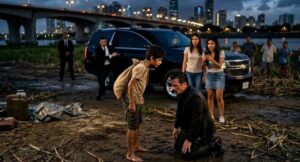
For most people, the riverbank was dirty.
For twelve-year-old Nico Mendoza, it was work.
He crouched beside the reeds with a torn burlap sack hanging from one shoulder and reached for a green soda bottle floating just beyond the mud.
Plastic bottles were worth almost nothing individually.
Enough of them could buy bread.
Sometimes beans.
If the recycling shop owner was in a generous mood, maybe a piece of fruit.
Nico had learned to measure days that way.
Ten bottles meant one possibility.
Twenty meant another.
Thirty meant he could stop searching before dark.
Three months earlier, he had not known the price of empty bottles.
He had gone to school.
He had complained when his grandmother made vegetable soup twice in one week.
He had owned two pairs of shoes.
One good.
One old.
His grandmother, Rosa Mendoza, had lived with him in a narrow apartment above a bakery in the San Miguel district.
Their windows rattled whenever buses passed.
The bathroom tap leaked.
The roof became unbearably hot in August.
Nico had believed they were poor.
After Rosa died, he discovered how comfortable their poverty had actually been.
Poverty with a bed was different.
Poverty with a locked door was different.
Poverty with someone asking whether you had eaten was different.
Now Nico slept wherever he could.
A church doorway when it did not rain.
A park bench when police patrols were light.
An abandoned kiosk near the old bus station when the older boys had not claimed it first.
He washed in public fountains before sunrise.
He carried everything he owned in a backpack and the burlap sack.
Still, one rule followed him.
Never steal.
Rosa had repeated it so often that Nico could hear her voice without trying.
“Being hungry can make your stomach empty, Nicolás.”
She was the only person who used his full name.
“But don’t let it make you empty in here.”
She would touch his chest.
“You can lose a house. Money. Shoes. Even people. Don’t help the world take your character too.”
Nico used to roll his eyes.
Now he protected those words more carefully than anything he owned.
He stretched farther toward the floating bottle.
His bare toes sank into warm mud.
Almost.
The bottle moved.
Nico reached again.
Then someone screamed.
“He fell!”
Nico looked up.
People were running toward the bridge.
A man had gone over the railing.
Nico dropped the bottle.
At first, all he saw were hands hitting the water.
Then a head appeared.
Dark hair.
A black suit.
The man tried to grab a concrete support but missed.
The current spun him sideways.
He vanished.
A crowd gathered almost instantly.
Tourists.
Vendors.
Two men in office shirts.
A woman carrying groceries.
Three teenagers with phones already raised.
“Call emergency services!”
“Someone get a rope!”
“He’s drowning!”
Nobody moved toward the water.
Nico ran closer.
“What are you waiting for?”
A large man wearing sunglasses grabbed his shoulder.
“Stay back.”
Nico pulled away.
“He went under!”
“Someone is coming.”
“Who?”
The man tightened his grip.
“The police.”
Nico looked at the river.
The drowning man surfaced again.
Only his face this time.
Then disappeared.
Police were not fast enough.
Everyone knew that.
The fire station was twenty minutes away when traffic was good.
The nearest river rescue unit was farther.
Nico kicked the man’s hand away.
“Boy!”
Nico ran.
He threw the burlap sack onto the dirt.
Someone shouted.
He ignored them.
The river hit him like cold metal.
The shock stole his breath.
For half a second, Nico panicked.
Then he remembered how Rosa taught him to swim.
Not here.
At a public pool years earlier.
She stood beside the shallow end yelling that he was kicking too hard.
“Water doesn’t care how angry you are!”
He could hear her now.
Nico kicked toward the bridge.
The current was stronger than it looked from shore.
Mud filled his mouth.
He spat.
The man appeared ten feet away.
Nico swam harder.
“Hey!”
No response.
“Grab me!”
The man’s eyes opened.
He saw Nico and panicked.
His arm swung wildly.
A fist struck Nico across the cheek.
Stars flashed across his vision.
“Stop!”
The man grabbed Nico’s shirt.
They both went under.
Nico fought upward.
The man’s soaked jacket felt impossibly heavy.
For one terrible second, Nico thought the stranger would pull them both down.
He twisted free.
“Stop fighting me!”
The man’s face appeared above water.
“I can’t—”
“Yes, you can!”
Nico moved behind him.
He had seen lifeguards do something similar in the pool.
He hooked one arm beneath the man’s chest.
“Lean back!”
The stranger coughed.
“Lean back or we both drown!”
Maybe it was the words.
Maybe exhaustion.
The man stopped fighting.
Nico kicked.
The river pushed sideways.
The shore seemed farther now.
His legs began burning.
Every breath hurt.
People were shouting.
Someone finally threw a rope.
It landed too far away.
Nico changed direction toward shallower water.
His toes touched something.
Mud.
He pushed.
The stranger coughed again.
“Almost.”
Nico did not know whether he was speaking to the man or himself.
Another step.
Then another.
He dragged the stranger through the shallows.
Hands reached down from the bank.
Several men pulled them onto the mud.
Nico collapsed on his back.
His chest rose violently.
The sky above him looked painfully bright.
For several seconds, nobody spoke to him.
Everyone surrounded the stranger.
Nico turned his head.
The man lay on his side coughing river water.
His expensive black suit was ruined.
Blood ran from a cut near his temple.
Then engines roared above the riverbank.
Three black SUVs stopped near the bridge.
Doors opened before the vehicles fully stopped.
Men in dark suits ran down the slope.
The crowd changed immediately.
Phones lowered.
Conversations stopped.
People stepped backward.
Nico noticed the man with sunglasses who had grabbed him earlier.
He was no longer looking angry.
He looked terrified.
One of the newcomers dropped beside the drowning man.
“Don Mateo!”
Nico stopped breathing.
The name spread through the crowd.
Mateo Vargas.
Someone whispered it.
Another person crossed himself.
Nico sat up.
Everyone in Ciudad de Esperanza knew Mateo Vargas.
Children knew.
Old women knew.
Taxi drivers knew.
Officially, Mateo Vargas owned shipping companies, casinos, warehouses, restaurants, security firms, and half the private parking garages near the port.
Unofficially, people said he controlled much more.
Customs officers.
Union leaders.
Police captains.
Smuggling routes.
Political donations.
People who challenged him often left the city.
People who betrayed him sometimes disappeared from conversation completely.
Rosa hated when neighbors repeated stories about him.
“Powerful men enjoy becoming legends,” she once told Nico. “Legends make everyone else afraid to ask for facts.”
Still, she never said Mateo was innocent.
Nico stared at the man he had dragged from the water.
Of all people.
Mateo coughed again.
A guard tried to lift him.
Mateo pushed his hand away.
“I can stand.”
His voice was rough.
The guards moved back.
Even soaked and coughing, he expected obedience.
Mateo stood slowly.
He scanned the crowd.
“Who pulled me out?”
Nobody answered.
The man with sunglasses looked toward Nico.
Then away.
Nico considered running.
He had saved the most feared man in the city.
That did not feel like good luck.
Mateo repeated the question.
“Who?”
Nico stood.
His legs shook.
“I did.”
A guard looked at him.
Then laughed.
Nico glanced down at himself.
Wet shorts.
Bare feet.
A shirt with one sleeve torn.
Mud on his knees.
He probably looked ridiculous.
Mateo did not laugh.
He walked toward him.
Up close, he was older than Nico expected.
Maybe forty-five.
Gray beginning at his temples.
A faint scar beneath one eye.
He looked exhausted rather than frightening.
Until his eyes focused.
Then Nico understood why adults became careful around him.
Mateo looked at people as though he expected the truth eventually, with or without cooperation.
“What is your name?”
Nico hesitated.
“Nicolás Mendoza.”
Mateo froze.
The guards behind him became quiet.
Nico noticed one older man near the SUV.
He had white hair and a thick mustache.
His face changed completely.
“Boss.”
Mateo did not turn.
The older guard whispered, “Rosa Mendoza’s grandson was supposed to be dead.”
Nico felt cold despite the sun.
“What?”
Mateo seized Nico gently but firmly beneath the chin.
He turned his face left.
Then right.
Studying him.
Nico slapped his hand away.
“Don’t touch me.”
Several guards moved.
Mateo lifted one finger.
They stopped.
He stared at Nico.
“Your grandmother was Rosa Esperanza Mendoza?”
Nico took one step backward.
“How do you know her?”
“What happened to her?”
“She died.”
“When?”
“Three months ago.”
Mateo’s jaw tightened.
“How?”
Nico hated the question.
He had repeated the answer too many times.
“The hospital said her heart stopped.”
“Which hospital?”
“Saint Gabriel.”
Mateo looked toward the older guard.
The man shook his head.
Something silent passed between them.
Nico became frightened.
“What?”
Mateo looked back at him.
“Who told you she had a heart attack?”
“A doctor.”
“Name?”
“I don’t know.”
“You don’t know?”
“I was twelve!”
His voice cracked.
“I was alone.”
The guards looked away.
Mateo’s face changed.
Only slightly.
“Where have you been living?”
Nico said nothing.
Mateo looked toward the empty burlap sack near the reeds.
Then at his bare feet.
Understanding arrived.
His expression hardened.
Not at Nico.
At something else.
“Who took care of you after she died?”
“No one.”
Mateo closed his eyes briefly.
The older guard muttered something under his breath.
Mateo leaned closer.
“Listen carefully, Nicolás.”
“My name is Nico.”
“Nico.”
Mateo lowered his voice.
“Your grandmother did not die the way they told you.”
Nico stared.
“What does that mean?”
Mateo turned toward his men.
“Bring the car.”
“No.”
Mateo looked back.
Nico stepped away.
“I’m not going anywhere with you.”
The older guard frowned.
“You just saved his life.”
“That doesn’t mean I want to get murdered afterward.”
One guard almost smiled.
Mateo did not.
“You’re right.”
The answer surprised Nico.
“You should not trust me because I know your grandmother’s name.”
“Good.”
“But staying here is dangerous.”
“I’ve been here three months.”
“And people believed you were dead.”
Nico’s stomach tightened.
“Why?”
Mateo looked toward the crowd.
Too many people were listening.
“Because whoever killed your grandmother believed they had solved two problems.”
Nico stopped breathing.
“You said she wasn’t—”
“I said not the way they told you.”
“You’re saying somebody killed her?”
Mateo looked directly at him.
“Yes.”
The world became strangely quiet.
Nico heard the river.
Cars on the bridge.
A bird somewhere in the reeds.
Rosa’s hands folding laundry.
Rosa complaining about electricity bills.
Rosa coughing in the kitchen during the final week.
She had died in a hospital bed while Nico waited outside.
A nurse told him she was gone.
Then a social worker promised to find him somewhere to stay.
Nico ran before they could put him in a group home.
He had believed that was the worst thing that happened.
Now Mateo Vargas was telling him there had been more.
Nico looked toward the road.
“I want my bag.”
Mateo nodded to a guard.
The guard retrieved Nico’s backpack and sack.
“I’m still not getting in your car.”
Mateo removed his wet jacket.
He looked absurd standing barefoot in expensive trousers while water dripped from his sleeves.
“What do you want?”
“The truth.”
“I cannot give it to you on a riverbank.”
“Then say enough.”
Mateo studied him.
“Your grandmother worked for my family.”
Nico frowned.
“No.”
“Yes.”
“She cleaned offices when she was young.”
“Among other things.”
“She hated criminals.”
Mateo’s mouth moved slightly.
“She hated stupidity more.”
Nico recognized that.
Rosa had once told a thief outside the bakery that stealing bread was understandable but stealing lottery tickets was evidence of bad planning.
“What did she do for you?”
Mateo looked away.
“She saved my mother.”
Nico stared.
“From what?”
“Me.”
That answer made no sense.
Mateo looked back.
“And later, she tried to save this city from men I should have stopped sooner.”
He nodded toward the SUV.
“If you want the complete truth, come with me.”
Nico crossed his arms.
“And if I don’t?”
“I will put two men nearby who you will never see, and tomorrow Daniel Reyes will come speak with you.”
“Who’s Daniel?”
“A prosecutor.”
Nico almost laughed.
“A prosecutor who works for you?”
Mateo’s expression became cold.
“No.”
That answer sounded important.
Nico looked at the guards.
Then the city beyond them.
He did not trust police.
He did not trust social workers.
He definitely did not trust Mateo Vargas.
But he had questions no one else could answer.
“Can I sit near the door?”
Mateo nodded.
“Yes.”
“If anybody locks it, I break the window.”
The older guard smiled.
Mateo said, “Agreed.”
Nico picked up his bag.
He entered the SUV.
The door remained unlocked.
The inside smelled like leather and coffee.
Nico had never sat in a car so clean.
He tried not to touch anything.
Mateo climbed in opposite him.
Another man drove.
The older guard sat in front.
Nobody spoke for several minutes.
Nico watched the river disappear behind them.
City of Hope passed outside the windows.
Fruit stands.
Apartment blocks.
Banks.
Police motorcycles.
Children wearing school uniforms.
People living normal afternoons.
Nico felt as though he had crossed into another version of the city.
“Where are we going?”
“A house.”
“Yours?”
“No.”
“Why not?”
“Too many people know mine.”
Nico looked at him.
“People are trying to kill you?”
Mateo touched the cut on his temple.
“That is one possibility.”
“You fell.”
“I was pushed.”
Nico stared.
“From the bridge?”
“Yes.”
“Who?”
“I don’t know yet.”
Nico leaned back.
“This day is terrible.”
The older guard laughed.
Mateo almost did.
The safe house stood in a quiet neighborhood behind a medical clinic.
It did not look like a mafia house.
No gates.
No marble lions.
No armed men visible outside.
Just a two-story home with faded yellow walls and potted plants near the door.
A woman opened it.
She looked around sixty.
Gray hair.
Glasses.
Plain blue dress.
When she saw Nico, she covered her mouth.
“Oh.”
Nico stopped.
“Who are you?”
The woman began crying.
“My name is Elena.”
She looked at Mateo.
“You found him.”
“I didn’t.”
Mateo glanced at Nico.
“He found me.”
Elena stepped closer.
Nico moved backward.
She stopped immediately.
“I’m sorry.”
“Did you know my grandmother?”
Elena nodded.
“For thirty years.”
“Then why didn’t you find me?”
Her face collapsed.
“We thought you were dead.”
Everyone kept saying that.
Nico hated it more each time.
“Why?”
Elena looked toward Mateo.
He answered.
“Because the apartment where your grandmother lived burned the night after her funeral.”
Nico stared.
“What?”
He had never returned.
After Rosa died, a social worker brought him to a temporary shelter.
Nico ran that night.
He assumed everything in the apartment was lost because the landlord changed the locks.
Nobody told him about a fire.
Mateo continued.
“Firefighters found remains.”
Nico’s stomach turned.
“What remains?”
“A child’s.”
He went cold.
“They thought it was me.”
“Yes.”
“Whose kid was it?”
“We don’t know.”
Nico backed toward the wall.
“No.”
Mateo stood.
“Nico.”
“No.”
He pressed both hands over his ears.
He did not want another dead child attached to his name.
Elena stepped forward.
Mateo shook his head.
She stopped.
Nico slid down the wall.
His breathing became fast.
Rosa dead.
Apartment burned.
Another child.
Someone believing Nico was dead.
It was too much.
Mateo crouched several feet away.
“Look at me.”
Nico did not.
“I’m not touching you.”
Slowly, Nico lowered his hands.
Mateo said, “You don’t need to understand everything today.”
“You said truth.”
“Yes.”
“Then tell it.”
Mateo sat on the floor.
The most feared man in Ciudad de Esperanza sat on an old tile floor across from a barefoot boy.
“All right.”
He began thirty years earlier.
Rosa Mendoza had been twenty-four when she started working nights cleaning the offices of Vargas Shipping.
Mateo’s father, Emilio Vargas, controlled most of the port’s illegal trade at the time.
Weapons.
Untaxed goods.
Stolen cars.
Cash.
Mateo did not soften the history.
“My father was a criminal.”
Nico stared.
“Everyone knows.”
“He was also violent.”
Mateo looked toward Elena.
The woman sat quietly near the table.
“My mother wanted to leave him.”
Elena was Mateo’s aunt, his mother’s younger sister.
Mateo continued.
“One night my father beat my mother badly enough that she could barely walk.”
Rosa found her in an office bathroom.
“She helped her escape.”
“How?”
“Put her in a laundry cart.”
Nico blinked.
Mateo almost smiled.
“That sounds like her.”
“It does.”
Rosa hid Mateo’s mother in her apartment for three days.
Then arranged transport out of the city.
Emilio Vargas discovered what happened.
He threatened Rosa.
She refused to reveal where his wife had gone.
“Why didn’t he kill her?”
“My mother threatened to give police records she had stolen.”
“Did she?”
“No.”
“Then why did he believe her?”
“Because Rosa told him she had copies.”
Nico almost smiled.
“She lied?”
“Very convincingly.”
Rosa survived.
Mateo’s mother eventually returned after Emilio promised to stop drinking and accept treatment.
The promise did not last.
Mateo grew up watching both parents remain inside a relationship held together by money, fear, and reputation.
Rosa remained connected to the family.
Not as an employee.
As someone Mateo’s mother trusted.
When Mateo was sixteen, he started running errands for his father.
Rosa confronted him.
“She slapped me.”
Nico’s eyebrows lifted.
“You?”
“Yes.”
“A mafia guy?”
“I wasn’t impressive at sixteen.”
“What did you do?”
“Told her to mind her business.”
“What happened?”
“She slapped me again.”
Nico laughed.
For the first time that day, the laugh felt natural.
Mateo smiled too.
“She told me becoming my father was not destiny unless I chose it.”
“Did you listen?”
“Not enough.”
The smile disappeared.
Mateo entered the family business anyway.
He told himself he would make it less violent.
He ended some operations.
Stopped others.
Shifted money into legal businesses.
But he kept control of the docks.
Kept men who bribed officials.
Kept relationships with corrupt police.
“I thought I was changing the system from inside.”
Rosa disagreed.
Nico said, “Grandma didn’t like excuses.”
“No.”
“She said excuses are stories people tell themselves after they already know better.”
Mateo looked at him.
“She told me exactly that.”
Years later, Rosa became a bookkeeper for a neighborhood charity funded partly by Vargas money.
She had learned accounting through night classes.
She began noticing transfers.
Small ones at first.
Money leaving legitimate shipping companies and passing through charities.
Then returning through construction contracts.
Someone was using Mateo’s legal businesses to move money from activities he claimed to have ended.
“Who?”
Mateo looked toward the window.
“My uncle Javier.”
Nico frowned.
“I thought you ran everything.”
“So did I.”
Javier Vargas was Mateo’s father’s younger brother.
He handled port security, labor relations, and political contacts.
When Mateo began moving operations toward legitimate business, Javier publicly supported him.
Privately, he continued smuggling.
Worse, he expanded into something Mateo claimed he had forbidden completely.
Human trafficking.
Nico’s face tightened.
Rosa found evidence.
Names.
Account numbers.
Payments to police.
Cargo manifests changed after ships arrived.
She copied everything.
“Why didn’t she go to police?”
“Some of the police were being paid.”
“Then prosecutors?”
“She tried.”
Mateo looked toward Elena.
“Daniel Reyes.”
The prosecutor he mentioned earlier.
“He met her twice.”
“What happened?”
“Someone inside his office leaked it.”
Nico whispered, “Javier.”
“Yes.”
Rosa realized she was in danger.
She hid evidence.
Then contacted Mateo.
“That was three months ago?”
“Four.”
“Before she got sick.”
Mateo nodded.
“She came to me.”
“What did you do?”
Silence.
Nico saw the answer before Mateo spoke.
“Not enough.”
Mateo looked ashamed.
“I told her I needed time.”
“For what?”
“To confirm it.”
“She already had proof.”
“I wanted my own.”
“You didn’t believe her?”
“I believed her.”
“Then why?”
“Because exposing Javier meant exposing half my organization and several political officials. I thought I could remove him quietly first.”
Nico stood.
“So you protected yourself.”
Mateo did not defend the choice.
“Yes.”
Nico’s hands tightened.
“Then she died.”
“Yes.”
“You knew she was in danger.”
“Yes.”
“And you waited.”
“Yes.”
Nico grabbed an empty glass from the table.
For one wild second, Mateo thought he might throw it.
Instead, Nico placed it down hard.
“You’re a coward.”
The older guard appeared in the doorway.
Mateo lifted a hand.
“Leave.”
The guard left.
Mateo looked at Nico.
“You’re right.”
That made Nico angrier.
“Stop agreeing!”
Mateo said nothing.
“You don’t get to say you’re sorry and make it disappear.”
“I know.”
“My grandma is dead.”
“I know.”
“You had cars. Men. Money.”
“Yes.”
“You could have protected her.”
“Yes.”
Nico began crying.
He hated crying in front of strangers.
He turned away.
Elena offered a towel.
He ignored it.
After a minute, he wiped his face with his shirt.
“How did she die?”
Mateo’s voice lowered.
“The hospital records say heart failure.”
“You said that’s wrong.”
“An independent doctor reviewed the preserved blood sample yesterday.”
Nico stared.
“Preserved?”
“Hospitals retain some samples temporarily.”
“What did they find?”
“A medication she was never prescribed.”
“What medication?”
“Something that slowed her heart.”
Nico sat again.
“So somebody poisoned her.”
“Yes.”
“At home?”
“We think so.”
Nico remembered Rosa’s last week.
She had been tired.
Dizzy.
She complained that tea tasted bitter one evening.
He had teased her about buying cheap tea.
She laughed.
Then three days later, she collapsed.
“Who gave it to her?”
“We don’t know yet.”
“Javier?”
“Likely.”
“Likely isn’t proof.”
Mateo looked at him.
“No.”
Rosa’s voice seemed to have survived inside Nico more strongly than either expected.
Nico asked, “What did she hide?”
“We don’t know.”
“You said evidence.”
“Yes.”
“Where?”
“That’s why they burned the apartment.”
“To find it?”
“Probably.”
“Did they?”
Mateo looked toward Elena.
“No.”
“How do you know?”
“Because Javier is still looking.”
That meant something.
Nico stood.
“I want to go.”
Mateo frowned.
“Where?”
“The bakery.”
“What bakery?”
“Under our apartment.”
The bakery owner, Señora Ruiz, had known Rosa for years.
If Rosa hid something outside the apartment, she might have trusted her.
Mateo stood.
“We go together.”
“No guards.”
“Impossible.”
“Then I’m not going.”
“Nico.”
“You said you need the evidence.”
“I need you alive more.”
“Why?”
Mateo became quiet.
“Because I owe your grandmother.”
“I don’t want to be your debt.”
The sentence hit him.
Mateo nodded.
“Fair.”
He agreed to one visible car and two guards who would remain outside.
They drove to San Miguel near sunset.
The bakery still stood.
The apartment above it was blackened.
Nico stopped on the sidewalk.
For three months, he had imagined returning.
Not like this.
The upper windows were gone.
Smoke stains covered the wall.
A city notice hung across the door.
Nico’s throat closed.
Mateo remained behind him.
He did not speak.
Señora Ruiz came out of the bakery holding a tray.
She saw Nico.
The tray fell.
Metal struck pavement.
“Nicholas?”
Nico barely had time to move before she wrapped both arms around him.
“Where have you been?”
He stood stiffly.
Then hugged her back.
She cried against his hair.
“We thought you died.”
“Everybody keeps saying that.”
She pulled away.
“I searched hospitals. Shelters. The police said—”
“I ran from the shelter.”
“You fool.”
She slapped his shoulder lightly.
Then hugged him again.
Only afterward did she notice Mateo.
Her face went pale.
Nico said, “He’s with me.”
That sentence sounded wrong.
Mateo nodded politely.
“Mrs. Ruiz.”
She did not return the greeting.
Good, Nico thought.
Rosa would have approved.
They entered the bakery.
The smell of bread nearly made Nico dizzy.
He had not eaten since morning.
Señora Ruiz placed a roll in front of him without asking.
Nico devoured half before remembering the question.
“Did Grandma give you anything before she died?”
The woman became still.
Mateo noticed.
“So she did.”
She looked at him sharply.
“I am speaking to the boy.”
Mateo stepped back.
Nico asked again.
“Did she?”
Mrs. Ruiz went into the kitchen.
She returned holding a small metal biscuit tin.
Nico recognized it immediately.
Rosa used to keep sewing supplies inside.
“She gave me this five days before she went to the hospital.”
“Why?”
“She said if anything happened, I should give it only to you.”
“Why didn’t you?”
“You disappeared.”
Nico opened the tin.
Thread.
Needles.
Buttons.
Nothing else.
Mateo frowned.
Nico smiled slightly.
“Grandma hated obvious hiding places.”
He removed the thin cardboard lining.
Underneath was a brass key.
And a folded note.
His hands shook as he opened it.
Nicholas,
If you are reading this, I was not able to explain things myself.
I am sorry.
You must not trust anyone simply because they knew me.
Especially powerful men.
Ask what they did when helping me became expensive.
The key belongs to locker 214 at the old central bus station.
Take what is there to Daniel Reyes.
Not police.
Not Mateo unless he has already chosen a side.
Remember what I taught you.
Fear tells you to survive.
Character tells you what kind of person survives.
Love,
Grandmother
Nico read it twice.
Then handed it to Mateo.
Mateo read one sentence and stopped.
Ask what they did when helping me became expensive.
His face tightened.
“She knew me well.”
Nico took the note back.
“Has already chosen a side.”
“Yes.”
“Have you?”
Mateo looked at him.
“I’m trying.”
“That isn’t an answer.”
“No.”
Mateo breathed slowly.
“I chose myself when she needed me.”
Nico waited.
“I’m not making that choice again.”
The old central bus station had been closed for renovation.
Daniel Reyes met them outside.
He was fifty-two, thin, and wore a suit that looked cheaper than Mateo’s shoes.
He shook Nico’s hand.
“Your grandmother talked about you constantly.”
“What did she say?”
“That you argued too much.”
Nico almost smiled.
The station manager opened the locker room.
Locker 214 contained a red backpack.
Inside were three flash drives, photocopied cargo manifests, photographs, a notebook, and an old voice recorder.
Daniel looked stunned.
Mateo did not touch anything.
“Evidence bags,” he told the prosecutor.
Daniel looked at him.
“You’re not taking custody.”
“I know.”
That mattered.
The notebook contained names.
Port officials.
Police officers.
Customs agents.
Politicians.
Shipping managers.
Payments went back years.
Some were linked to Javier Vargas.
Others pointed higher.
One name appeared repeatedly.
Police Commissioner Tomás León.
The same man who had announced publicly that Rosa died naturally.
Nico stared at the page.
“He knew?”
Daniel nodded.
“He signed off on the original investigation.”
Mateo’s face became hard.
“He also controls the river patrol.”
Everyone looked at him.
The bridge.
Mateo had been pushed into the water.
“The river wasn’t an accident,” Daniel said.
“No.”
“Javier knows you’re investigating.”
“Yes.”
“And now he knows the boy is alive.”
Mateo turned toward Nico.
“We move him tonight.”
Nico crossed his arms.
“Stop deciding things.”
Mateo closed his eyes.
Right.
“What do you want?”
“I want somewhere safe.”
“Okay.”
“Not your house.”
“Agreed.”
“With Señora Ruiz if she wants.”
The baker looked alarmed.
Then determined.
“Yes.”
Mateo shook his head.
“Her apartment isn’t secure.”
Nico glared.
Mateo corrected himself.
“Would you consider a protected apartment arranged by Daniel, with Señora Ruiz staying too?”
Nico looked at Daniel.
“Not owned by Vargas?”
“No.”
“Police?”
“Federal witness protection unit.”
Nico thought about it.
“Okay.”
The investigation moved quickly after that.
Not because Mateo controlled it.
Because the evidence was strong enough that several agencies could no longer safely ignore it.
Daniel sent copies to federal prosecutors in three separate offices.
One set went to an international anti-trafficking task force.
Another went to a judge outside Ciudad de Esperanza.
No single official could bury everything.
Mateo provided his own records.
That was the choice Rosa had demanded.
He did not provide only evidence against Javier.
He provided evidence against himself.
Bribes.
Illegal payments.
Old smuggling arrangements.
Political donations designed to purchase influence.
His attorney nearly shouted at him.
“You are confessing to crimes that are not even part of the investigation.”
“Yes.”
“You could lose everything.”
“Yes.”
“You could go to prison.”
“Yes.”
“Why?”
Mateo looked toward the window.
“Because I spent twenty years telling myself I was better than my father while using the same protections.”
His lawyer rubbed his forehead.
“You could cooperate narrowly.”
“That is what Rosa asked me to stop doing.”
Mateo negotiated a cooperation agreement.
Not immunity.
He would testify.
Surrender control of several companies.
Pay large penalties and restitution.
His legitimate businesses would be placed under independent management.
His illegal operations would be dismantled.
In return, prosecutors considered his cooperation when determining charges.
Nico did not know most of this at first.
He spent his days in the protected apartment with Señora Ruiz.
For the first time in months, he had a bed.
A shower.
Clean clothes.
Shoes.
He hated the shoes.
They pinched.
Señora Ruiz told him that was because he had spent too long barefoot.
A teacher visited to assess how much school he missed.
Nico pretended not to care.
Then finished three math worksheets in one hour.
“You’re ahead,” she said.
“My grandma made me do homework before dinner.”
He looked down.
The teacher said nothing.
That kindness helped.
Mateo visited only when Nico agreed.
Their first visit after the locker discovery was awkward.
Mateo arrived carrying a box.
Nico frowned.
“What is that?”
“Shoes.”
“I have shoes.”
“These are better.”
“I don’t want them.”
Mateo looked at Señora Ruiz.
She shook her head.
“You were warned.”
Mateo took the box away.
The next time, he brought nothing.
Better.
They sat on the balcony.
“What happens to you?” Nico asked.
“I don’t know.”
“You’re going to jail?”
“Possibly.”
Nico studied him.
“Are you scared?”
“Yes.”
The honesty surprised him.
“People are scared of you.”
“I know.”
“Does that help?”
“No.”
Mateo looked toward the street.
“Fear is expensive.”
“What does that mean?”
“You spend years making people afraid to tell you the truth. Then one day you need the truth and discover you have surrounded yourself with liars.”
Nico thought about Rosa’s note.
“Grandma told you?”
“In different words.”
Nico smiled slightly.
The investigation reached Javier Vargas two weeks later.
He tried to flee through a private airfield.
Federal agents stopped him.
Commissioner León was arrested the same morning.
Several port officials followed.
The city exploded with rumors.
People assumed Mateo had won an internal mafia war.
That irritated Nico.
“He’s losing too,” he told Señora Ruiz while watching television.
She looked at him.
“What?”
“They keep saying he took down Javier.”
“He helped.”
“He took down himself too.”
She studied him.
“That distinction matters to you?”
“Yes.”
“Why?”
“Because otherwise people think he became good by beating a worse man.”
Mrs. Ruiz smiled.
“You sound like Rosa.”
Nico hated and loved hearing that.
The evidence surrounding Rosa’s death became clearer.
A home-care nurse visited her twice during the week before she collapsed.
The woman was not employed by any registered agency.
Security footage from a pharmacy showed her purchasing the medication found in Rosa’s preserved blood sample.
Her phone records connected her to one of Javier’s security managers.
She was arrested in another state.
At first, she denied everything.
Then the records became impossible to explain.
She confessed to placing medication in Rosa’s evening tea over several days.
Not enough to kill immediately.
Enough to weaken her heart gradually.
The plan was to make the death look natural.
Commissioner León arranged the hospital report.
After Rosa died, Javier’s men searched the apartment.
They did not find the evidence.
So they burned it.
The child found in the fire was identified later.
His name was Luis Calderón.
Thirteen years old.
Another homeless boy who sometimes slept in abandoned buildings.
He entered the apartment after the search, likely looking for food or valuables.
The fire began while he was inside.
Nico cried when Daniel told him.
“He died because they thought the apartment was empty.”
“Yes.”
“They thought he was me.”
“At first.”
“Does his family know?”
Daniel nodded.
“His mother lives in another state. She had been looking for him.”
Nico sat quietly.
“I want to meet her.”
Daniel hesitated.
“Why?”
“To tell her I’m sorry.”
“For what?”
“They buried him under my name.”
“That wasn’t your choice.”
“I know.”
Daniel arranged a meeting months later.
Luis’s mother, Maribel, was a factory worker with tired eyes.
Nico did not know what to say.
He had prepared sentences.
All disappeared.
Finally, he whispered, “I’m sorry.”
Maribel hugged him.
“You are not the person who owes me an apology.”
They cried together.
Nico never forgot that.
Justice could identify guilty people.
It could not redistribute grief fairly.
Mateo’s case took longer.
He testified before a federal grand jury.
Then in open court against Javier and several officials.
His reputation changed.
Some called him a traitor.
Others called him a hero.
Nico disliked both.
Mateo had committed crimes.
He had also exposed them.
Those truths did not cancel each other.
During Javier’s trial, Rosa’s voice recorder became important evidence.
She had recorded a meeting.
Javier spoke openly about the port routes.
Commissioner León discussed police payments.
Then Mateo’s name appeared.
Javier said, “Mateo doesn’t need to know.”
León laughed.
“He always knows enough to stay guilty and not enough to feel responsible.”
In the courtroom, Mateo closed his eyes.
That sentence described the life he had built.
Nico was not present.
Daniel did not want him exposed to the trial.
But years later, he read the transcript.
Mateo pleaded guilty to racketeering-related financial crimes, bribery, and conspiracy connected to older operations.
His cooperation reduced the sentence significantly.
Still, he went to prison.
Before sentencing, he asked to see Nico.
By then, nearly a year had passed since the river.
Nico was thirteen.
He lived with Señora Ruiz, who had become his legal guardian after a long court process.
She reopened a smaller bakery near their new apartment.
Nico returned to school.
He complained about uniforms.
That made everyone happy.
He met Mateo in a federal detention visiting room.
No black suit.
No guards.
No expensive watch.
Mateo wore a plain gray uniform.
He looked smaller.
Nico sat across from him.
“So.”
Mateo smiled.
“So.”
“How long?”
“Seven years.”
Nico stared.
“That sounds like a lot.”
“It is.”
“You could’ve gotten more?”
“Yes.”
“Because you helped?”
“Yes.”
Nico thought about that.
“Do you think Grandma would say it’s fair?”
Mateo laughed softly.
“She would say fairness is not a number.”
“That sounds like her.”
“She would also say I was lucky.”
“You are.”
“Yes.”
They sat quietly.
Then Mateo said, “I sold the casino interests.”
“Good.”
“The shipping company is under independent management.”
“Good.”
“The restitution fund was approved.”
Nico frowned.
“What fund?”
“Money from my assets will compensate trafficking victims and families affected by the port operations.”
“Your idea?”
“Partly Daniel’s.”
“Then it’s probably smarter.”
Mateo smiled.
“There is also a trust for your education.”
Nico’s face hardened.
“No.”
“It isn’t a gift.”
“No.”
“Listen.”
“I don’t want mafia money.”
“Neither would Rosa.”
“Then why?”
“Because the money comes from the legal estate my mother left me.”
Nico remained suspicious.
“And?”
“Your grandmother protected my mother. She also spent years doing unpaid work to expose crimes tied to companies I controlled.”
“That’s still debt.”
“Yes.”
“I told you I don’t want to be your debt.”
Mateo nodded.
“You did.”
“Then don’t.”
“The trust is not controlled by me. Daniel and Señora Ruiz would oversee it.”
“No.”
Mateo looked surprised.
Nico continued.
“Use it for Luis’s mother too.”
Mateo became quiet.
“And the other families.”
“You’re thirteen.”
“So?”
“So you negotiate like Rosa.”
“That isn’t an answer.”
Mateo laughed.
“No.”
The education trust became a broader scholarship fund for children affected by organized crime and public corruption.
Nico remained eligible.
So did many others.
That mattered to him.
He did not want the story of saving a powerful man to become a lottery ticket.
Three years passed.
Ciudad de Esperanza changed slowly.
Not magically.
The port still had corruption.
Police still made mistakes.
Other criminal groups tried to fill spaces left behind.
But several old networks were gone.
Independent oversight increased.
Daniel Reyes became head of a special anti-corruption office.
He complained constantly and slept too little.
Señora Ruiz’s bakery became successful enough that she hired four people.
Nico worked Saturdays.
She paid him.
He complained about the wage.
She threatened to reduce it.
He stopped complaining.
At sixteen, Nico was taller than Rosa had been.
He kept her note inside a plastic sleeve in his desk.
Ask what they did when helping me became expensive.
That sentence became a test he used on everyone.
Teachers.
Politicians.
Friends.
Himself.
It was easy to believe in principles when principles cost nothing.
The river rescue had taught him that too.
He had jumped because a man was drowning.
He did not know the man’s name.
He did not know whether the stranger deserved saving.
He only knew that no one else moved.
For years, journalists tried to interview him.
THE STREET BOY WHO SAVED MATEO VARGAS.
THE CHILD WHO ENDED A CRIMINAL EMPIRE.
Nico refused.
“I didn’t end anything,” he told Daniel.
“You helped.”
“I swam.”
“And found the evidence.”
“Grandma did that.”
“You carried it forward.”
“Because she left instructions.”
Daniel smiled.
“You are extremely committed to avoiding compliments.”
“Compliments make people stupid.”
“Rosa again?”
“Probably.”
At seventeen, Nico visited Mateo in prison for the final time before his release.
Mateo had changed.
More gray hair.
Less certainty.
He spent his prison years completing business-law courses and helping teach literacy classes.
Nico teased him.
“You became a teacher.”
“Don’t spread it around.”
“Your reputation would be ruined.”
“Exactly.”
Mateo asked what Nico planned after high school.
“Law.”
Mateo smiled.
“Daniel infected you.”
“Maybe accounting.”
“Rosa.”
“Maybe engineering.”
Mateo laughed.
“You don’t know.”
“No.”
“Good.”
Nico frowned.
“Why good?”
“At twelve, you had no home. At seventeen, not knowing means you have choices.”
Nico sat with that.
Mateo was right.
He hated admitting it.
When Mateo was released, he did not return to Ciudad de Esperanza permanently.
Terms of his supervision limited several business activities.
Most of his former assets were gone or independently managed.
He moved to a small coastal town.
People still recognized him.
Fear lingered longer than power.
He and Nico exchanged occasional letters.
No father-son relationship.
No adoption.
No dramatic inheritance.
That would have felt false.
Mateo had known Rosa.
He owed her.
Nico had saved him.
They became something harder to name.
Two people connected by the consequences of choices made long before either understood them fully.
At eighteen, Nico graduated near the top of his class.
Señora Ruiz cried before the ceremony began.
Daniel arrived late because of court.
Maribel Calderón came with a photograph of Luis.
Nico had invited her.
An empty seat beside her held a small white flower.
For Pink.
Nico gave the graduation speech.
He hated public speaking.
His teacher told him that was not a valid excuse.
He stood behind the microphone and looked at hundreds of families.
He did not tell the river story.
Everyone already knew it.
Instead, he talked about witnesses.
“Most important moments don’t begin when everyone is ready,” he said.
“They happen while people are busy, frightened, poor, tired, or unsure.”
He looked toward Mrs. Ruiz.
“When I was younger, I thought courage meant not being afraid. I know now that’s wrong.”
Daniel smiled.
Nico continued.
“Fear gives information. It tells us something may cost us. The question is whether the cost changes what we know is right.”
He paused.
“My grandmother once told me poverty can empty your stomach without emptying your soul. For years, I thought she was talking about stealing food.”
Several people laughed softly.
“She meant more than that.”
Nico looked toward the empty seat.
“She meant there are many kinds of poverty.”
“A person can have money and still be poor in courage.”
“A person can have power and still be poor in honesty.”
“A person can have a respected name and still be too afraid to do what becomes expensive.”
He thought about Mateo waiting while Rosa remained in danger.
Daniel initially hesitating when his office leaked.
Helen? No, different story. He thought about the people on the riverbank holding phones while a stranger drowned.
Then himself.
A barefoot boy who had been frightened too.
“I don’t know what any of us will become,” Nico said. “But I hope when something important becomes expensive, we remember that is exactly when our choices start meaning something.”
After the ceremony, Daniel hugged him.
“You stole that from Rosa.”
“I improved it.”
“Dangerous confidence.”
Mrs. Ruiz pulled Nico away for photographs.
Mateo sent a letter.
It contained only three lines.
Your grandmother would have complained that your speech was too long.
Then she would have saved a copy.
I did too.
Nico laughed when he read it.
Years later, he chose law.
Not corporate law.
Not criminal defense.
Public-interest law focused on corruption and victim compensation.
People assumed Mateo Vargas paid for his education.
Technically, the scholarship fund helped with part of it.
Nico also worked.
He insisted on loans for the rest.
Señora Ruiz called that stubborn.
Daniel called it unnecessarily expensive.
Nico called it his decision.
At twenty-five, he returned to Ciudad de Esperanza after law school.
The city had changed.
New buildings along the river.
More lights.
The bridge had been repaired.
A metal safety barrier now ran along the pedestrian side.
Nico stood near the spot where he once collected bottles.
The water remained brown.
Some things resisted symbolism.
He carried shoes now.
Good ones.
He wore a suit.
Not as expensive as Mateo’s had been.
More comfortable.
A boy near the reeds searched for bottles.
Nico watched him.
Then walked down the bank.
“Hey.”
The boy looked suspicious.
“What?”
“You should wear shoes down here.”
“You buying some?”
Nico smiled.
“Maybe.”
“I don’t take charity.”
That sounded familiar.
“Good.”
Nico sat on a concrete block.
“Then tell me where the recycling place is.”
“Why?”
“I haven’t been here in years.”
The boy pointed.
Nico gave him money for directions.
The boy stared.
“That’s too much.”
“Then carry my bag to the bridge.”
“What bag?”
Nico handed him his briefcase.
The boy looked offended.
Then laughed.
They walked up together.
Nico did not ask his story.
Not yet.
Helping people did not require immediately turning them into projects.
That was another thing he had learned.
Near sunset, Nico stood alone on the bridge.
He thought about the afternoon twelve years earlier.
A man drowning.
A crowd watching.
Cold water.
Mateo’s hand hitting him in panic.
Rosa’s name changing Mateo’s face.
For years, people described that rescue as the moment Nico’s life changed.
They were right.
But not for the reason they thought.
Saving Mateo did not make Nico rich.
It did not give him a new father.
It did not make him heir to a criminal empire.
It gave him a question.
What had the adults around Rosa done when protecting her became expensive?
Mateo hesitated.
Daniel had been compromised.
Police lied.
Javier killed.
Others looked away.
Rosa acted anyway.
She gathered evidence knowing the danger.
Nico once asked Daniel whether that meant she had been reckless.
Daniel answered carefully.
“Maybe.”
The answer surprised him.
“She had you.”
“Yes.”
“She should have protected herself too.”
“Yes.”
“Then was she wrong?”
“People can do something brave and still take terrible risks.”
That answer mattered.
Nico did not want Rosa turned into a saint.
She had hidden things from him.
Taken risks.
Trusted Mateo longer than she should have.
She made mistakes.
Her courage remained real.
So did the cost.
Mateo eventually chose a side.
Too late for Rosa.
In time for other people.
That did not erase his past.
It changed his future.
Nico had learned not to demand cleaner stories than life could provide.
He rested his hands on the bridge railing.
A car stopped behind him.
He turned.
Mateo Vargas stepped out.
Older now.
Sixty.
No guards.
Plain gray jacket.
Nico stared.
“How did you know I was here?”
“Daniel.”
“Traitor.”
“He said you’d complain.”
Mateo walked beside him.
They looked at the river.
“You remember exactly where?”
“Yes.”
“I don’t.”
Nico glanced at him.
“You were unconscious.”
“Convenient excuse.”
They stood quietly.
Mateo asked, “Do you ever wish you hadn’t jumped?”
Nico thought about it.
“No.”
“Even knowing who I was?”
“I didn’t know when I jumped.”
“That isn’t what I asked.”
Nico looked toward the water.
“If I knew everything?”
“Yes.”
Javier.
Rosa.
The corruption.
Mateo’s crimes.
His delayed choice.
Everything.
Nico answered slowly.
“I still would.”
Mateo looked surprised.
“Why?”
“Because drowning isn’t a trial.”
Mateo waited.
Nico continued.
“I didn’t have to decide whether your life was worth your past. You were in the water.”
The older man looked down.
“That sounds like Rosa.”
“It sounds like me.”
Mateo smiled.
“Good.”
A breeze moved across the bridge.
Nico asked, “Do you regret not protecting her?”
“Every day.”
“Does that help?”
“No.”
“Good.”
Mateo laughed softly.
“You remain cruel.”
“No. I remain accurate.”
They watched the river.
After several minutes, Mateo said, “I used to think power meant making sure nobody could force me into a choice.”
“And now?”
“It means choices find you anyway.”
Nico nodded.
“That speech is too long.”
“Rosa would agree.”
The sun dropped behind the buildings.
Below them, bottles gathered again among the reeds.
Nico remembered reaching for one with an empty stomach and bare feet.
He remembered believing survival was the only problem he had left.
Then someone screamed.
He ran.
Nothing afterward had been simple.
But simplicity had never been Rosa’s promise.
She had promised something harder.
You could lose almost everything and still decide what remained inside you.
Nico had lost his home.
His grandmother.
His childhood certainty.
Mateo had lost his empire.
His freedom.
His illusion that partial reform excused partial guilt.
Ciudad de Esperanza had lost several of the men who once seemed untouchable.
None of those losses automatically created goodness.
What mattered was what people built afterward.
Nico eventually helped Daniel establish a legal center bearing no wealthy family’s name.
It represented trafficking survivors, families harmed by corrupt police, and children left without guardians after organized-crime cases.
The first plaque proposed for the entrance carried Rosa’s name.
Nico refused.
“She hated plaques.”
Daniel argued.
“She deserves recognition.”
“Put her name on the library.”
“Why?”
“She loved books.”
So they did.
THE ROSA MENDOZA LEGAL LIBRARY.
Inside were free computers, legal guides, children’s books, and an old framed note.
Not the original.
Nico kept that.
A copy.
Ask what they did when helping me became expensive.
Students asked about the sentence.
Nico usually gave the same answer.
“That’s when you find out what people really value.”
Years later, a young law student challenged him.
“That sounds harsh.”
“Why?”
“Sometimes people are afraid.”
“Yes.”
“Sometimes they have families.”
“Yes.”
“Sometimes helping means risking everything.”
“Yes.”
The student frowned.
“So what are you saying? Everyone should sacrifice themselves?”
“No.”
Nico smiled.
“I’m saying fear should be part of the decision, not the person making it for you.”
The student thought about that.
Nico had needed decades to understand it.
Rosa had not wanted him fearless.
Fearless people were often foolish.
She wanted him unwilling to sell his soul cheaply.
There was a difference.
On the fifteenth anniversary of Rosa’s death, Nico visited her grave.
For years, the marker had said only:
ROSA ESPERANZA MENDOZA
BELOVED GRANDMOTHER
Now someone had placed flowers.
Nico suspected Mateo.
He never asked.
He sat beside the grave.
“I bought shoes,” he said.
Silence.
“They’re expensive.”
More silence.
“You’d complain.”
A bird moved through the trees.
Nico smiled.
“I still don’t steal.”
He looked down.
“I lie sometimes.”
He imagined Rosa raising an eyebrow.
“Lawyer.”
That excuse would not have impressed her.
Nico touched the grass.
“You were right about one thing.”
He paused.
“Actually, many things. Don’t get excited.”
Wind moved across the cemetery.
“Being poor wasn’t the worst thing that happened to me.”
He looked toward the city.
“The worst thing was thinking nobody would notice if I disappeared.”
That belief had been wrong.
Rosa had prepared for him.
Mrs. Ruiz searched.
Daniel remembered.
Mateo carried guilt.
Even Maribel Calderón, whose own son died in the fire, made room for Nico’s grief.
People had noticed.
They had simply failed to find him in time.
Nico stood.
Before leaving, he placed a small plastic bottle beside the flowers.
Not trash.
Clean.
Empty.
A ridiculous memorial.
Rosa would have understood.
The afternoon he pulled Mateo Vargas from the Río Verde, the crowd thought the important revelation was the drowning man’s identity.
The feared boss.
The black SUVs.
The guards.
The dangerous name.
Nico eventually understood the real revelation came moments later.
His own name had mattered too.
Not because Mendoza carried wealth.
Not because it controlled businesses.
Because one woman with very little money had left enough truth behind to frighten men who believed they owned an entire city.
Rosa’s power had never looked like Mateo’s.
She had no guards.
No casinos.
No police chiefs answering calls.
She had records.
Memory.
Stubbornness.
And the courage to make copies.
Mateo once commanded people through fear.
Rosa changed people by making it difficult for them to lie to themselves.
In the end, her kind of power lasted longer.
Nico walked out of the cemetery and toward the bus stop.
A black car waited near the entrance.
Mateo sat inside.
The window lowered.
“Ride?”
Nico looked at the bus approaching.
Then at him.
“Does the door lock?”
Mateo smiled.
“Still worried?”
“Always.”
“Good.”
Nico opened the car door.
Before getting inside, he looked once more toward Rosa’s grave.
Then he sat near the door.
Exactly as he had the first time.
Mateo noticed.
Neither said anything.
The car pulled away.
Not toward an empire.
Not toward secrets.
Just toward dinner.
And for Nico Mendoza, after everything that had happened, an ordinary dinner with no one hiding the truth was more valuable than any legend Ciudad de Esperanza had ever told.