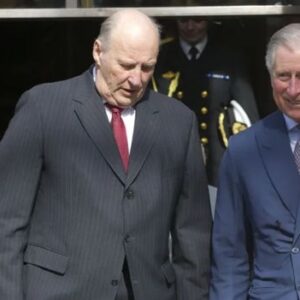
King Haakon VIII Takes the Norwegian Throne as Nation Mourns the Death of King Harald V at 89


Norway has entered a new royal era following the death of King Harald V at the age of 89, as his only son, Crown Prince Haakon, formally succeeds him as King Haakon VIII.
The transition came amid an extraordinary outpouring of grief across Norway. Hundreds of mourners gathered outside the Royal Palace in Oslo, laying flowers and lighting candles in memory of a monarch who had spent more than three decades on the throne.
The Royal Court announced that King Harald died peacefully at Oslo University Hospital, Rikshospitalet, at 6:35am on Friday, August 28, after his health deteriorated following an infection.
Harald had been receiving treatment for haemolytic anaemia, a condition in which red blood cells are destroyed more rapidly than normal. His recent health struggles had raised concerns about his ability to continue carrying out his duties, but the king had repeatedly insisted that he would not abdicate.
Now, at 53, his son has stepped into the role he spent decades preparing for.
Haakon, previously Norway’s Crown Prince, is officially His Majesty King Haakon VIII. He and his wife, Queen Mette-Marit, have two children: Princess Ingrid Alexandra, 22, and Prince Sverre Magnus, 20.
The succession also places Ingrid Alexandra in a historic position. As second in line to the Norwegian throne, she could eventually become the country’s first reigning queen in more than six centuries, following Queen Margaret I, who died in 1412.
But the new reign begins during an exceptionally difficult period for the Norwegian Royal Family.


Mette-Marit has faced intense public scrutiny following revelations concerning her past contact with Jeffrey Epstein. Documents released in the so-called Epstein Files indicated that she had stayed at Epstein’s Palm Beach residence in 2013, after his conviction for soliciting sex from underage girls. Another email appeared to suggest that contact between the pair continued later.
Mette-Marit subsequently said she had been misled by Epstein and expressed regret over the relationship.
The family’s troubles deepened in June when her son, Marius Borg Høiby, was convicted of two rape charges and sentenced to four years in prison. The court also found him guilty of assaulting his former girlfriend, issuing threats and traffic offences, while acquitting him of two other rape charges.
Høiby, now 29, grew up closely connected to the Norwegian Royal Family after his mother married the then Crown Prince Haakon in 2001. He does not hold a royal title or undertake official royal duties.
Against this backdrop, Haakon’s accession marks not simply a change of monarch, but the beginning of a new chapter for a family facing intense public attention.
His father, meanwhile, leaves behind a remarkable royal legacy.

King Harald and Queen Sonja posing at the Royal Palace after their wedding ceremony in August 1968


Born on February 21, 1937, Harald was the only son of King Olav V and Princess Märtha. His childhood was shaped by the Second World War. When Nazi Germany invaded Norway in 1940, the young prince and his mother and sisters were evacuated, eventually spending much of the war in the United States.
His father and grandfather, King Haakon VII, continued the Norwegian resistance from abroad before the royal family returned to Norway after the war.
Harald became Crown Prince in 1957 following his grandfather’s death. He later studied at the University of Oslo and the Norwegian Military Academy before continuing his education at Oxford.
Away from royal duties, sailing was one of his great passions. He represented Norway at three Olympic Games — Tokyo in 1964, Mexico City in 1968 and Munich in 1972.
His personal life also became part of Norwegian royal history.
Harald fell in love with Sonja Haraldsen, the daughter of an Oslo draper. Because she was a commoner, their relationship initially faced resistance from the Palace. Harald reportedly made it clear that he would remain unmarried rather than give up the woman he loved.
His father eventually gave his approval, and the couple married at Oslo Cathedral in 1968.
They went on to have two children, Princess Märtha Louise and Haakon.
Harald finally became king in January 1991, at the age of 53 — the same age at which his own son now takes the throne.
During his 35 years as monarch, Harald developed close relationships with European royal families, particularly Britain’s. He was a cousin of King Charles III, with the two sharing great-great-grandparents King Edward VII and Queen Alexandra of Denmark.


Following Harald’s death, Charles paid tribute to his cousin, remembering him as a much-loved family member whose kindness, compassion and sense of duty had endured across decades.
The British and Norwegian royal families have long shared particularly close historical ties, strengthened during the Second World War.
Now, as Norway mourns the end of Harald’s reign, the attention turns to the man who has waited more than three decades to succeed him.
King Haakon VIII begins his reign with a nation grieving for his father — and with the Norwegian monarchy entering a new and closely watched chapter.