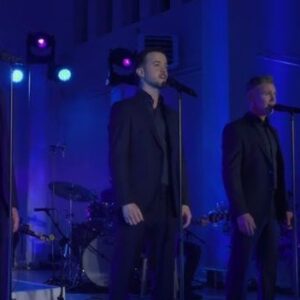
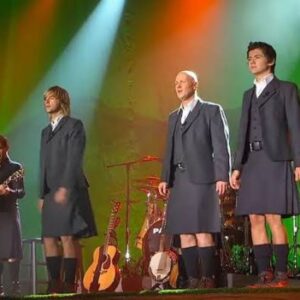
Some singers perform a song. George Donaldson had a way of making you feel as though he had lived every word.
That quality was at the heart of his performances with Celtic Thunder, particularly in “Streets Of New York.” He never needed dramatic vocal flourishes or elaborate staging to hold an audience. His voice, warmth and storytelling were enough.
Years after his death, however, the performance carries a different kind of emotional weight.
Donaldson died suddenly in March 2014 at the age of 46. Today, recordings of him with Celtic Thunder offer fans something they could never have anticipated when those performances were filmed: a chance to hear his familiar voice and see him perform again.
A Story Told Through Song
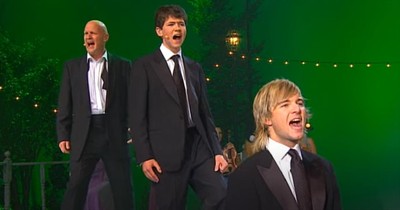
“Streets Of New York” suited Donaldson’s strengths as a performer.
His voice had a natural warmth and depth, while his delivery was understated enough to keep the story at the center. Rather than trying to force an emotional response, he allowed the song to unfold naturally.
That approach made the performance feel almost conversational.
Instead of simply singing about New York, the song evokes the emotions surrounding distance, memory, home and the experience of carrying one part of your life with you while building another somewhere else.
Donaldson understood how to make that kind of material feel personal.
Celtic Thunder’s official catalog also preserves “Streets Of New York” among Donaldson’s performances, including the group’s Live & Unplugged release, filmed at Sullivan Hall in New York in December 2012.

The Meaning Changed After 2014
When audiences first watched Donaldson perform, there was no reason to think of the recording as anything other than a moment from a living performer’s career.
There would be more concerts.
More songs.
More opportunities to hear that voice.
Then Donaldson died suddenly in 2014.
The footage itself remained exactly the same, but the people watching it had changed.
A smile that once seemed like an ordinary part of a performance can suddenly feel precious. A familiar line can carry a different emotional weight. And a song that once lasted only a few minutes can become a reminder of how much has disappeared with time.
The Celtic Thunder website remembers Donaldson as a key soloist who joined the group in 2008 and became known for his warm personality, storytelling and performances. He was also the group’s only Scotsman and received Irish Music Awards in 2011 and 2012.

The Recording Never Changes
There is something unusual about returning to an old performance after an artist has died.
The recording remains fixed in the past.
Donaldson does not know that decades later, fans would return to these performances with a different understanding of what they mean. He simply appears onstage, sings the song and carries on with the performance.
For those watching now, that creates an almost surreal sense of connection.
For a few minutes, the distance between then and now seems to disappear.
The stage is still there. The voice is still there. The performance still unfolds exactly as it once did.
Only the circumstances surrounding it have changed.

Why George’s Voice Still Matters
Celtic Thunder has continued through different lineups and eras since its first performance in 2007, with successive singers bringing their own styles to the group.
But certain voices become permanently connected to particular memories.
Donaldson’s is one of them.
His appeal was never simply about singing the biggest note in the room. His strength was his ability to inhabit a story and make the listener feel as though it was being shared directly with them.
That is why “Streets Of New York” remains so affecting.
The performance does not need to change to become more meaningful.
Time changes the listener.

A Few Minutes With George Again
Perhaps that is the most bittersweet gift these recordings provide.
George Donaldson is gone, but the performances remain.
Press play, and his voice still sounds as familiar as it did when he stood onstage with Celtic Thunder. The years between then and now seem to fall away, if only for the length of a song.
The recording cannot bring him back.
But it can preserve something unmistakably George — his voice, his presence and the storytelling that made his performances memorable.
The song is still here.
And for a few precious minutes, so is the feeling of hearing George Donaldson sing again.