Five contestants. Thirty seconds. £97,000 on the line. Yet not a single finalist managed to crack Lee Mack’s deceptively simple word puzzle — and the answer was hiding in six capitalised words all along.
The tension was building inside The 1% Club studio as five remaining contestants faced the biggest decision of the game. They could walk away with £10,000 to share between them or risk everything on the notoriously difficult final question for a shot at the entire £97,000 jackpot.
All five decided to take their chances.
But what followed was a spectacular collective failure.
Lee Mack presented them with a seemingly ordinary sentence containing six capitalised words. Their task was to identify the single word that connected all six.
They had just 30 seconds.
As the countdown began, the pressure quickly mounted. Some contestants left their answer sheets blank, while others took a gamble on guesses that ultimately proved incorrect.
When the clock ran out, the result was extraordinary: not one of the five finalists had found the answer.
And when Lee finally revealed the solution, it became clear just how cleverly the puzzle had been constructed.

CAN YOU SOLVE THE £97,000 QUESTION IN JUST 30 SECONDS?
The challenge appeared on the ITV quiz show on 3 May, when 100 contestants began the familiar journey through increasingly difficult logic and reasoning questions.
The rules were straightforward. Every eliminated contestant added £1,000 to the prize pot. Players could also use a pass to skip a question or take their £1,000 and leave the competition.
By the final round, only five contestants remained.
They now faced a choice: split £10,000 between them or continue playing for the full jackpot, which had climbed to an impressive £97,000.
They chose the jackpot.
Lee then delivered the final challenge:
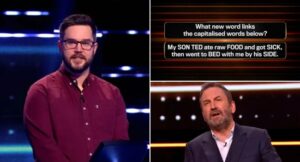
“My SON TED ate raw FOOD and got SICK, then went to BED with me by his SIDE.”
The contestants had 30 seconds to identify the one word that could connect all six capitalised words.
At first, the sentence looked completely ordinary. SON, TED, FOOD, SICK, BED and SIDE seemed to have little in common.
But there was a hidden connection.
And the five finalists simply couldn’t see it.

THE ANSWER WAS JUST THREE LETTERS — BUT NOBODY FOUND IT
THE CORRECT ANSWER
SEA
The trick was to place the word SEA before each of the six capitalised words, creating a completely new word:
- SON → SEASON
- TED → SEATED
- FOOD → SEAFOOD
- SICK → SEASICK
- BED → SEABED
- SIDE → SEASIDE
Suddenly, the entire sentence made sense.
Six seemingly unrelated words were connected by one tiny three-letter answer.
Once Lee revealed the solution, the pattern seemed almost ridiculously obvious. Yet with only 30 seconds to think, none of the five contestants had managed to spot it.
The consequence was brutal: the £97,000 jackpot went unclaimed, and all five finalists missed their chance to take home the prize.
It was a perfect example of how The 1% Club can turn something that looks incredibly simple into a surprisingly difficult test of concentration.

WHY THE 1% CLUB’S HARDEST QUESTIONS ARE SO DECEPTIVE
The show’s appeal lies in its ability to challenge the way people think.
Unlike traditional general-knowledge quizzes, The 1% Club rarely rewards contestants simply for memorising facts. Instead, its puzzles rely on wordplay, numerical patterns, lateral thinking and details that are easy to overlook.
Over the course of the series, contestants have faced plenty of similarly deceptive challenges, including:
- The alphabetical number puzzle: What is the first number whose letters appear in alphabetical order when spelled out?
- The number-code challenge: If January equals 717, March equals 5315 and June equals 4624, what does August equal?
- The palindrome mileage puzzle: Lee notices that his milometer reads 16961, a number that reads the same backwards and forwards. What is the next mileage that will do the same?
- The word association puzzle: What do “Into”, “Therefore”, “Evaluate” and “Benign” have in common?
- The famous bat-and-ball question: A bat and a ball cost £1.10 altogether. The bat costs £1 more than the ball. How much does the ball cost?
Each question requires contestants to abandon their first instinct and look for a different way of interpreting the information in front of them.
That’s precisely what made the £97,000 challenge so frustrating.
The answer wasn’t buried in complicated calculations or obscure knowledge. It was a simple word that could be placed before six others to create familiar expressions.
Yet the ticking clock made all the difference.

FIVE FINALISTS, £97,000 AND ONE WORD THEY COULDN’T SPOT
For the contestants on 3 May, the final question became an expensive lesson in the power of lateral thinking.
They had made it through the competition, survived the earlier challenges and reached the final five. The full £97,000 was within reach.
But 30 seconds wasn’t enough.
And perhaps that’s the most frustrating part of the puzzle: once you know the answer is SEA, those six words suddenly look completely different.
NOW THE QUESTION IS: WOULD YOU HAVE SPOTTED THE THREE-LETTER TRICK BEFORE LEE MACK REVEALED THE ANSWER — OR WOULD YOU HAVE LEFT EMPTY-HANDED TOO?