Saturday Night Live Unleashes Brutal Cold Open Mocking Pete Hegseth And RFK Jr. — As One Navy Sailor’s Question Sparks An Outrageous Exchange
Saturday Night Live delivered a provocative opening sketch targeting two prominent members of President Donald Trump’s administration, turning a military homecoming into a chaotic display of political satire.
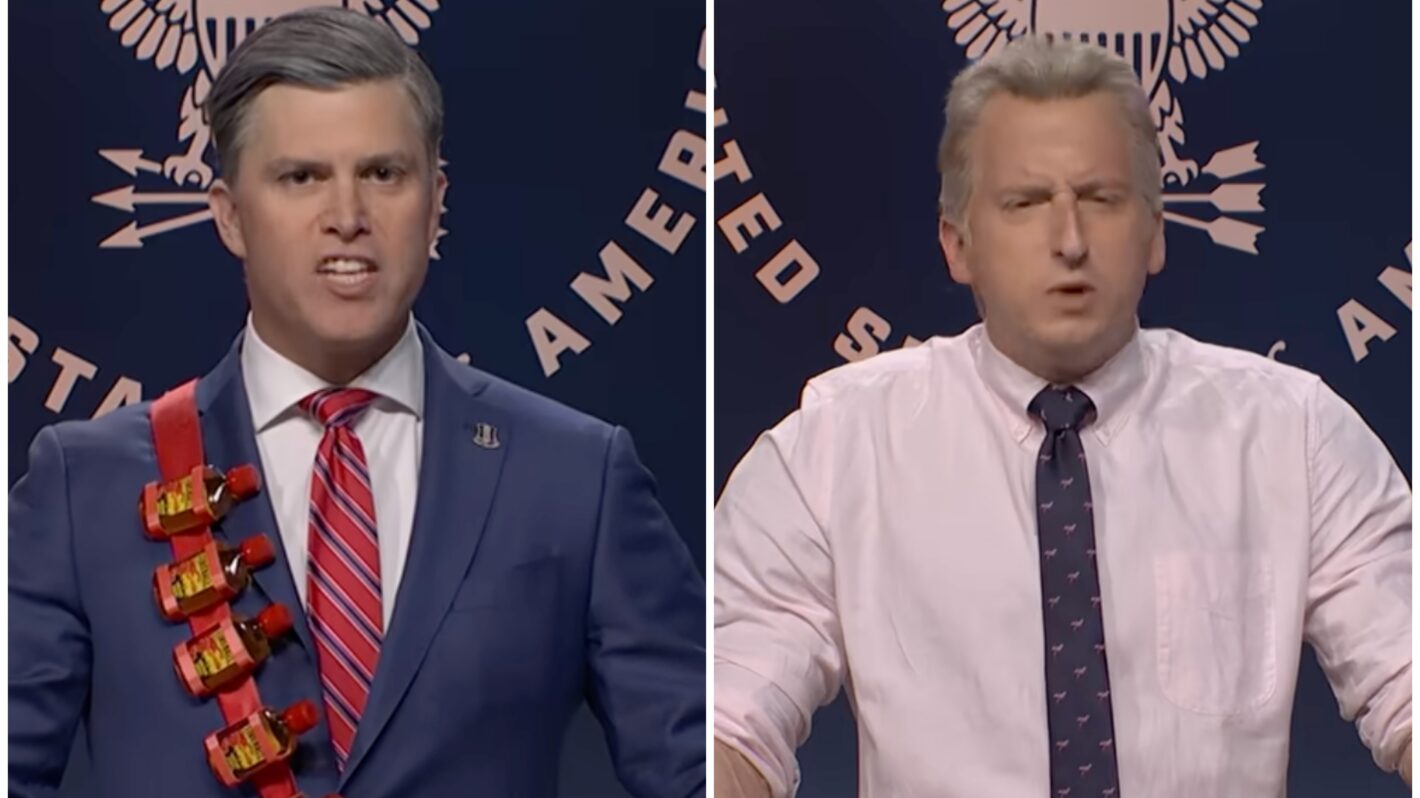
The NBC comedy series opened its latest episode with Colin Jost portraying Secretary of War Pete Hegseth and James Austin Johnson taking on the role of Health and Human Services Secretary Robert F. Kennedy Jr.
Set aboard the USS Abraham Lincoln following its lengthy deployment, the sketch imagined the two officials addressing exhausted Navy personnel who had finally returned home.
But instead of offering a straightforward tribute to the sailors, the fictional speeches descended into a series of increasingly outrageous remarks about military life, government policy and public health.
One exchange involving a redesigned military emblem proved especially provocative, while Kennedy’s appearance pushed the absurdity even further.
By the time the sketch reached its final punchline, almost nothing had escaped the show’s satirical treatment.
Colin Jost Transforms Into Pete Hegseth For A Chaotic Military Welcome
The cold open began with Colin Jost appearing as Pete Hegseth in front of sailors aboard the USS Lincoln.
The fictional setting drew inspiration from the aircraft carrier’s return to San Diego after a deployment lasting more than 320 days.
Jost’s costume immediately established the exaggerated tone of the sketch.
Instead of ordinary military accessories, his version of Hegseth wore an ammunition belt made from miniature bottles of Fireball Cinnamon Whiskey.
The unusual detail set the stage for a character portrayed as aggressively confident, confrontational and seemingly disconnected from the sailors’ experiences.
He began by addressing the assembled service members, awkwardly acknowledging both men and women.
When he asked how they were doing, one sailor responded that they were feeling bad.
Hegseth deliberately interpreted the answer as positive.
The exchange established a recurring joke: the fictional secretary seemed determined to celebrate the deployment regardless of what the sailors actually said.
The Sketch Takes A Dark Turn Over The USS Lincoln’s Deployment

As the speech continued, Jost’s Hegseth congratulated the sailors on returning to San Diego.
However, the remarks quickly veered into deliberately absurd territory.
The character joked that President Trump had asked Iran to attack the city, transforming what should have been a reassuring welcome into another source of anxiety.
He then delivered a series of dark jokes about the sailors’ experiences during deployment.
The fictional speech referenced thousands of combat missions, problems aboard the ship and the emotional strain of prolonged military service.
Rather than acknowledging the hardships seriously, Hegseth treated them as material for an increasingly inappropriate celebration.
The contrast between the sailors’ exhaustion and the character’s enthusiasm became one of the sketch’s central comedic devices.
The humor was intentionally uncomfortable, using exaggeration to criticize what the writers portrayed as a disconnect between political leadership and military personnel.
These claims were part of the fictional comedy routine, not verified accounts of events aboard the aircraft carrier.
A Question About The Department Of War Logo Leads To A Confrontation
One of the sketch’s most provocative moments came when Hegseth introduced what he described as a newly unveiled Department of War logo.
A sailor immediately questioned the design.
The emblem appeared to resemble imagery associated with Nazi Germany, prompting the sailor to challenge the secretary about its appearance.
Instead of offering a serious explanation, Jost’s Hegseth delivered an intentionally outrageous response.
He described it as an American eagle with a Nazi-inspired appearance.
When the sailor continued to question the similarity, Hegseth abandoned any attempt at explanation and responded with a crude personal insult.
The exchange was designed to escalate rapidly from an uncomfortable question into an absurd confrontation.
It also illustrated the sketch’s portrayal of Hegseth as a figure who responds to criticism with bluster rather than reassurance.
The segment was satire; it did not establish that an actual Department of War logo had been introduced with the meaning suggested in the dialogue.
Hegseth Delivers More Outrageous Claims About Life Back Home
The sketch also imagined Hegseth briefing the sailors on developments they had supposedly missed while deployed.
Rather than discussing ordinary news, he launched into an exaggerated description of a proposed televised execution.
The character suggested that a man using a wheelchair would face a firing squad.
He then added another absurd twist, claiming that if the prisoner survived, he would have to fight social media personality and boxer Jake Paul.
The sequence combined references to politics, entertainment and celebrity culture.
Its increasingly ridiculous premises were intended to highlight the character’s lack of restraint.
As the jokes became more extreme, the sailors’ reactions reinforced the central idea that their supposed welcome-home briefing was anything but reassuring.
Then the sketch introduced its second major political target.
James Austin Johnson Appears As Robert F. Kennedy Jr.
James Austin Johnson entered the scene portraying Robert F. Kennedy Jr., shifting the sketch from military satire to public-health policy.
Johnson, known for his political impressions on Saturday Night Live, adopted an exaggerated version of Kennedy’s distinctive speaking style.
His character began by announcing that the United States was healthier than ever.
But almost immediately, he undermined that declaration with a list of illnesses and bizarre medical concerns.
The fictional Kennedy proposed renaming the traditional cold and flu season to include several other diseases.
The joke referenced listeria, measles and an invented condition called trench brain.
He also introduced another absurd phrase, testicular dementia.
The intentionally nonsensical medical terminology formed part of the show’s criticism of the administration’s approach to public-health messaging.
Rather than presenting genuine medical information, the writers used increasingly strange statements to make the character appear confused and unreliable.
RFK Jr. Makes Bizarre Claims About Recalled Meat
Johnson’s Kennedy continued by referring to a large-scale recall involving pork, beef and goat meat.
The sketch cited a figure of 200,000 pounds.
Instead of offering a conventional public-health warning, the fictional secretary suggested that Americans could turn to unusual alternative protein sources.
These included catfish, pony and cricket.
The character then thanked the sailors for supposedly testing the meat, adding another surreal element to the speech.
As the monologue continued, Kennedy’s words became increasingly difficult to understand.
Eventually, the character began speaking in apparent gibberish.
Jost’s Hegseth responded by slapping him on the back.
The physical gag caused Kennedy to resume speaking clearly.
The moment offered a visual punchline to the show’s exaggerated portrayal of the health secretary’s voice.
Linkin Park Makes An Unexpected Appearance In The Final Moments
The sketch’s conclusion brought the attention back to Hegseth.
After the chaotic appearances and bizarre policy claims, the fictional secretary attempted to close his address with a message of appreciation for the sailors.
But even that final tribute took an unusual turn.
Jost’s character began singing part of Linkin Park’s hit song In the End.
The unexpected musical reference added another layer of absurdity to a speech that had already moved through several unrelated subjects.
He then thanked the sailors for being willing to go down with the ship.
However, the remark immediately became the setup for another crude joke.
The sketch concluded with the familiar announcement introducing Saturday Night Live.
It was a fitting ending for a cold open that had consistently replaced solemnity with deliberately inappropriate humor.
Why The USS Lincoln Setting Made The Sketch Particularly Striking
The decision to stage the sketch aboard the USS Abraham Lincoln gave the political satire a recognizable setting.
The aircraft carrier had recently completed a lengthy deployment, making its return a significant event for sailors and their families.
A military homecoming would ordinarily be associated with celebration, relief and appreciation for those who had been away from home.
Saturday Night Live inverted those expectations.
Instead of focusing on the sailors’ accomplishments, the fictional officials repeatedly distracted from their experiences with self-serving remarks and outrageous claims.
The contrast allowed the writers to criticize political leadership while using the sailors as the more grounded characters in the scene.
Their confused and uncomfortable reactions helped emphasize the absurdity of the speeches.
The setting also gave the show an opportunity to bring together military policy, public-health issues and political personalities within a single opening segment.
SNL Continues Its Tradition Of Political Satire
Political impressions have long been a defining feature of Saturday Night Live.
The series regularly uses its opening sketches to parody prominent government figures and respond to major developments in American public life.
This episode continued that tradition by focusing on two members of Trump’s cabinet rather than centering the entire sketch on the president himself.
Colin Jost’s portrayal of Hegseth relied on exaggerated confidence, confrontational behavior and deliberately inappropriate remarks.
James Austin Johnson’s RFK Jr. impression took a different approach, using unusual medical claims and an exaggerated vocal performance to generate humor.
Together, the characters created a chaotic version of an official military address.
The jokes were frequently provocative, particularly those involving military hardship, extremist imagery and public-health concerns.
As with much of the show’s political comedy, the aim was not to reproduce an actual government briefing but to use recognizable public figures as the basis for satire.
A Military Homecoming Turns Into An Unforgettable Comedy Sketch
The cold open transformed a moment normally associated with gratitude and celebration into a deliberately outrageous political performance.
Jost’s Hegseth arrived wearing whiskey bottles, dismissed the sailors’ concerns and became involved in a heated exchange over a fictional military emblem.
Johnson’s Kennedy followed with increasingly bizarre health claims before the sketch concluded with a Linkin Park reference and a final crude punchline.
The result was an unusually wide-ranging opening segment that targeted military leadership, public-health messaging and the administration’s public image.
What began as a fictional welcome-home speech for sailors aboard the USS Lincoln became one of the show’s most provocative political sketches, with Colin Jost and James Austin Johnson delivering a relentless series of exaggerated jokes about Pete Hegseth and Robert F. Kennedy Jr. From the controversial eagle exchange to the bizarre medical claims, the cold open left little room for subtlety — and made clear that both cabinet officials were firmly in the show’s comedic sights.