Paul McCartney Crashed Neil Young’s Hyde Park Finale — And Turned “A Day in the Life” Into Four Minutes of Beautiful Chaos

Neil Young had been carrying one of The Beatles’ most ambitious songs with him for decades before Paul McCartney finally stepped onto the stage and helped bring it full circle.
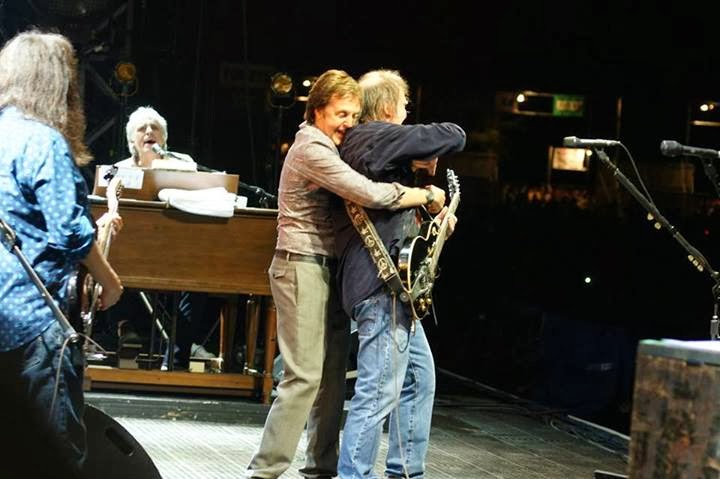
The unforgettable moment came at London’s Hyde Park on June 27, 2009, when Young was closing out a long stretch of performances with his thunderous interpretation of The Beatles’ 1967 masterpiece, “A Day in the Life.”
By then, the song had become a dramatic fixture in Young’s live show. But this particular night was different.
As Young launched into the classic, McCartney suddenly appeared onstage — joining him to sing the section he had originally written and recorded more than four decades earlier.
For the audience, it was the kind of collaboration that seemed almost impossible until it was happening directly in front of them.
A Beatles Classic Neil Young Had Carried for 30 Years
Young’s connection to “A Day in the Life” went back much further than his 2009 performance.
During his legendary 1978 Rust Never Sleeps tour, the Beatles recording was reportedly played over the PA before Young walked onstage each night. Yet despite his admiration for the track, he didn’t begin performing it himself until his European tour in the summer of 2008.
And Young certainly didn’t approach it like a museum piece.
His version was loud, ragged and unmistakably his own, gradually transforming the carefully constructed Beatles recording into an enormous wall of distorted guitar. For roughly the following year, it became one of the most explosive ways he could close a concert.
Then Hyde Park gave the song an ending nobody could have planned better.
Paul McCartney Suddenly Walked Onstage
McCartney and Young were hardly strangers.
The two musicians had been friends for years and had previously performed together, including appearances at the 2004 Bridge School Benefit, where they joined forces on Young’s “Only Love Can Break Your Heart” and The Beatles’ “Hey Jude.”
Young’s admiration for McCartney was equally well documented.
When he inducted McCartney into the Rock and Roll Hall of Fame in 1999, Young described him as one of history’s greatest songwriters and predicted that his work would still be remembered centuries later.
Ten years after that tribute, Young found himself playing one of McCartney’s greatest compositions — with McCartney standing beside him.
Rather than turning the performance into a polished recreation of the Beatles recording, the pair embraced the wildness of Young’s arrangement.
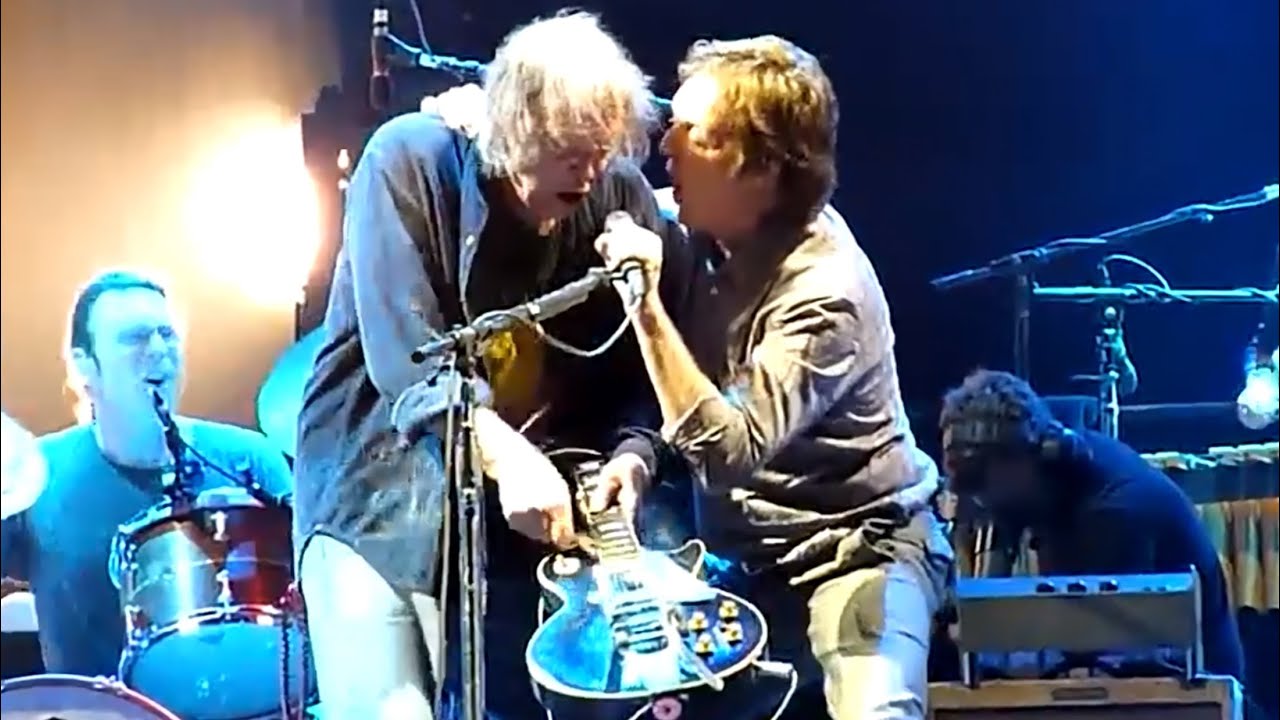
McCartney delivered his familiar portion of the song while Young attacked his guitar, and after the recognizable structure disappeared, neither man seemed particularly interested in ending the moment.
What followed was approximately four extraordinary minutes of feedback, distortion and glorious rock-and-roll noise.
McCartney stayed right there with Young as the performance dissolved into controlled chaos.
It wasn’t a conventional duet between two legends politely taking turns in the spotlight.
It looked more like two lifelong musicians rediscovering why making noise with guitars had excited them in the first place.
Two Legends, One Remarkable Full-Circle Moment
The performance carried an especially fitting symbolism.
Young had spent decades admiring The Beatles and McCartney, while McCartney was now watching one of rock’s most uncompromising guitarists completely reinvent a song he had helped create in 1967.
There was no attempt to reproduce the past perfectly.
Instead, they allowed “A Day in the Life” to become something new.
And perhaps that was precisely why the performance worked so well.
More than 40 years after The Beatles recorded the song, Paul McCartney walked onto a Hyde Park stage and found Neil Young tearing it apart — then happily joined him.
For several unforgettable minutes, two of rock music’s most influential careers collided in one gloriously unpredictable performance.
And when the final waves of feedback finally disappeared into the London night, Hyde Park had witnessed something far rarer than another all-star guest appearance:
a Beatles masterpiece returning to one of its creators — through the hands of another legend who had loved it for decades.