A departure without luggage, but with a heavy soul
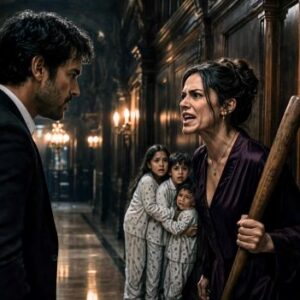
I walked past my mother with small steps, so small that I felt like I wanted to stop time, even though I knew there was no turning back. The clay floor of the old house, which she had swept so carefully every Saturday, seemed to suddenly lengthen beneath my feet, turning the path to the tent into a painful eternity. I took nothing with me. Not those good clothes from the dowry chest, which we had sewn together by lamplight, not the photograph of my father that I kept hidden under my pillow, not even the white silk scarf that I kept sacredly for the days of great celebration. I went out the gate wearing only the simple cotton dress I was wearing and a heart that felt shattered, like a mirror shattered by the stones of the road. In the street, the air was thick and warm; the sun was descending wearily behind the tall crowns of the acacias, casting long, purple shadows over the neighboring fences. Chickens gathered restlessly by the fences, and the dust raised by the carts returning from the fields lingered in the air. The village seemed unchanged, the same place where I had grown up, but I felt in every fiber of my being that I was no longer the frightened, obedient girl of the morning. I was a woman who had just lost her roots in order to find her wings.
The threshold that changed everything
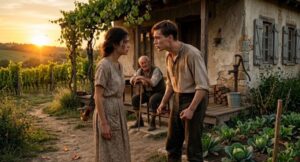
I went straight to Petre’s house, without looking back, for fear that if I had, I would have collapsed in pain right there, in the middle of the road. When he saw me at the gate, standing there alone and trembling, Petre understood everything without me saying a single word. His gaze, usually cheerful and full of life, suddenly darkened. He came towards me quickly, with long steps, but stopped a few steps away from me, hesitating, as if he was afraid that if he touched me I might disappear like smoke. “Elena… what happened? Why are you like this?”, he asked me, his voice trembling slightly. Then I burst into tears, a cry that came from deep in my stomach, releasing all the tension built up during the hours of arguing with my mother. “I left, Petre. My mother told me never to come back if I choose you,” I told him through sobs. Petre’s face turned white as if all the blood had drained from his cheeks. He didn’t rejoice, he didn’t start jumping up that we were finally together. He didn’t pull me into his arms like in a beautiful story from a romance novel. He lowered his head, his shoulders slumped, and whispered so softly that I could barely hear him: “For me, you lost your home, Elena… For me, you lost your mother.” I took his rough hands in mine and told him with a determination I didn’t know I possessed: “No, Petre, it’s not your fault. For you, I chose my life, not the death of my soul.”
The blessing of a poor man but rich in soul
His father, old man Ilie, was sitting as usual on the porch, leaning on his cherry wood cane. He was a weak man, worn by years and hard work, with eyes sunken in their sockets, but which retained an infinite kindness, like deep wells of cold water. He looked at us for a while in silence, judging the gravity of the moment, then, in a hoarse but warm voice, he said: “Come in, children. The house is small, the ceiling is low, but the heart is never measured in the number of rooms or the height of the walls.” Thus began my life as a married woman, under the roof of a house where it rained through the ceiling, but where love was the only thing that was never lacking. I had my wedding after only two weeks. We didn’t have many fiddlers, we didn’t have tables spread out all over the street, and no expensive gifts in money or land. Only a few big-hearted neighbors came, Petre’s father, and the village priest who had known us since we were little. No one came from my side. Not even an aunt, not even a distant cousin. In the church, while the priest was placing our wedding rings on our heads and blessing our union, I looked towards the door until the last second, hoping against all logic that I would see my mother enter, crying and forgiving me. She didn’t come. After the wedding, I cried silently under the walnut tree in the yard, and Petre squeezed my hand so tightly that it left marks on my skin, as if he wanted to convey to me through his blood: “You will never be alone, as long as I breathe.”
Hard winters and small joys
Years of hardship followed that today’s youth cannot imagine. In winter, the wind blew furiously through the cracks in the wood, and we put old rags on the windows so that we wouldn’t wake up covered in snow in our sleep. In summer, we worked whatever we could during the day, digging, harvesting, with our backs bent under the scorching sun. Petre always left before the first roosters crowed and only returned late at night, his palms cracked from work and his clothes soaked in sweat, but he never complained. In our first winter together, we only had two thin, worn-out blankets. I put one over old man Ilie, because he was old and the disease was eating away at his bones, and under the other we slept, pressed together to keep warm. “Are you cold, Eleno?” he often asked me in the middle of the night, feeling me shiver. “No, I’m not cold,” I lied through gritted teeth, but he knew. He took off his thick wool coat and put it over me, leaving himself uncovered, despite my protests. That’s how Petre was always, a man who would have given his last breath to make me feel better.
The wealth that is born from love
After a year, when the snow was melting and the first snowflakes were piercing the ground, our first child, Ionel, was born. We brought him into the world on a night of torrential rain, when the village roads had turned into rivers of mud and the midwife reached us with great difficulty, wet to the skin. When Petre took the little one wrapped in well-washed burlap in his arms for the first time, he started crying like a baby. “Look, Elena… now we really have wealth. We have someone to live for,” he said with wet eyes. And that’s exactly how I felt. Then Maria came, after another three years. Our house was still small, still poor in objects, but their laughter, their games in the empty weft, made it seem more spacious than any boyar’s mansion. Mother didn’t come to see her grandchildren then either. Not when they were born, nor when they took their first steps. Even when Grandfather Ilie passed away and we buried him on a cold, gray November day, my mother did not appear at the gate. Sometimes I would see her at the village fair, watching from afar how she grew older, how she walked more slowly, her back more and more bent. But whenever our eyes accidentally met, she would turn her head with a coldness that cut me like a knife. Don’t think it didn’t hurt. You can choose love with all your conviction and still miss your mother. You can be the happiest woman in your house and still feel the sting of the door that was slammed in your face decades ago.
The patience of the earth and the soul
The years passed over us, leaving marks on our faces, but strengthening our bond. Petre worked until his hands became like tree bark, but he managed to build, brick by brick, two more rooms for the children. He planted vines in the yard, young apple trees by the fence, and a large walnut tree right in front of the house, where I had cried on my wedding day. “This will shade our grandchildren when we are no more,” he would say, caressing the sapling’s thin trunk. And that walnut tree grew with our children. Ionel learned to read and became a mechanic in the city, a respected man, and Maria became a teacher, teaching the children of the village to be good and dignified. I couldn’t give them silk clothes or a lot of money, but I gave them a house where peace reigned. They never heard screaming between their parents, saw no fighting, felt no fear of returning home. They only saw two tired, often hungry people holding hands at the kitchen table.
An encounter with the past
One golden autumn, almost twenty-five years after I left my parents’ house, Gheorghe, the mayor’s son – the one my mother wanted me to marry for his lands – returned to the village for a memorial service. I hadn’t seen him in a lifetime. He was well-dressed, wearing expensive city clothes, but he had such sad eyes that you felt like crying out of pity. I learned from the neighbors that he had had three failed marriages, children scattered all over the world who no longer wrote to him, and a large, two-story house where no one was waiting for him with a hot cup of tea or a kind word. He greeted me politely when we met on the street. “Elena… you were brave then. Much braver than I was,” he told me with a bitter smile. I didn’t know what to answer him at the moment. Maybe I hadn’t necessarily been brave in the classical sense. Maybe I had just been young, in love, and refused to sell my soul for an extra hectare of land. But life showed me, through the contrast with Gheorghe’s fate, that sometimes the heart sees much further than fear or material interest.
The forgiveness that comes at sunset
My mother came to my door only when she was over seventy. It was a mild spring day, with the smell of freshly cut grass. I was hanging out the white laundry in the yard, and Petre, with slow movements, was cleaning the vines from the dry shoots. I heard the unmistakable creak of the wooden gate. When I turned my head, my heart stopped. It was her. She seemed so small, so weak, with her black scarf pulled low over her forehead and her hands trembling on the handle of a basket. For a second, I became that nineteen-year-old girl again, my heart clenched with fear. I didn’t know whether to run to her and hug her or stay where I was, protecting my hard-earned peace. Mother looked long at our house, the walnut tree that now cast a thick shadow, the snapdragon flowers by the porch, then looked at Petre, who had stopped working with scissors in his hand, looking at her with respect, without a trace of hatred. “Elena…”, she said so softly that her voice was lost in the breeze. Just my name, but it was loaded with everything she hadn’t told me in the last quarter of a century. Tears instantly came to my eyes. She approached with heavy steps, leaning against the fence, and took out of her bosom, next to her heart, the photograph of my father. It was old, yellowed at the edges, eaten away by time. “I kept it for you, your father would have been proud of you,” she handed it to me with trembling hands. I took the photograph and felt the circle closing. “Why did you come only now, mother?”, I asked her without reproach, but only with immense sadness. He sighed deeply, a sigh that seemed to take all the air out of a tired chest. “Because I’m old enough to understand that a house full of wealth can be emptier than a cave if there’s no love in it. I’ve lived in abundance and died of loneliness every day.” Then he looked at Petre, who had approached us. “Forgive me, boy. I didn’t think… I never thought you could make her happy with your bare hands.” Petre wiped his dirt-stained palms on his pants and took the old woman’s hand. “I did what I could, auntie. She built the rest of the happiness, with her patience.” My mother cried then, a sincere cry, without the mask of pride that had possessed her for so long. I never asked her why she abandoned me for so many years. Some wounds don’t need logical explanations to heal, just an outstretched hand, even if it comes far too late.
The light at the end of the road
My mother stayed with us for the last two years of her life. It wasn’t long, but it was enough to make up for lost time, in her own silent way. She would sit by the stove in the winter, a cup of tea in her hands, and watch her grandchildren and great-grandchildren with mute fascination. One December evening, she called me to her bedside. “Elena… you chose well. Better than I could ever have chosen for you,” she whispered to me before closing her eyes forever. In that moment, I felt a huge stone, a weight I had carried on my soul for fifty years, break loose and crumble. My mother left peacefully, and we buried her next to my father, where she belonged.
Today, when I look back, I am almost seventy years old. Petre has snow-white hair, he walks with increasing difficulty, leaning on the same cane that his father used, but he has the same warm hands that reach for my hand every morning. He still puts my cup of tea on the table before he sits down, a small gesture that is worth more than all the riches in the world. Our house is not a palace even now, but today our great-grandchildren play under the old walnut tree, and the yard is full of life. When the children ask me to tell them another story, I always tell them the same thing: Never choose a man by how much gold he has in his pockets, but by how much light he carries in his eyes. Wealth can be lost in a night, houses can collapse in an earthquake, lands can be sold or taken away by the waters. But the man who holds your hand when you have nothing and makes you feel as if you own the whole world… that is the only wealth that really matters. I left my mother’s house completely empty-handed, but I managed to live the fullest and richest life a woman can have. And today, when I watch Petre smile at me over the steam of my tea, I know that was the best decision of my life.