
The 1% Club Question Looks Like The Answer Should Be One — But The Real Number Catches People Out
The percentage only needs to fall from 99% to 98%, so surely barely anyone needs to leave the room. Unfortunately, that seemingly obvious logic leads you straight into the trap.
Some The 1% Club questions are difficult because the pattern is almost impossible to see.
Others are much more dangerous because the answer feels obvious almost immediately.

This question firmly belongs in the second category.
It gives you 100 people, two percentages and one very simple instruction. There are no strange symbols to decode and no obscure pieces of general knowledge standing between you and the answer.
But if your immediate response is one person, you might want to have another look.
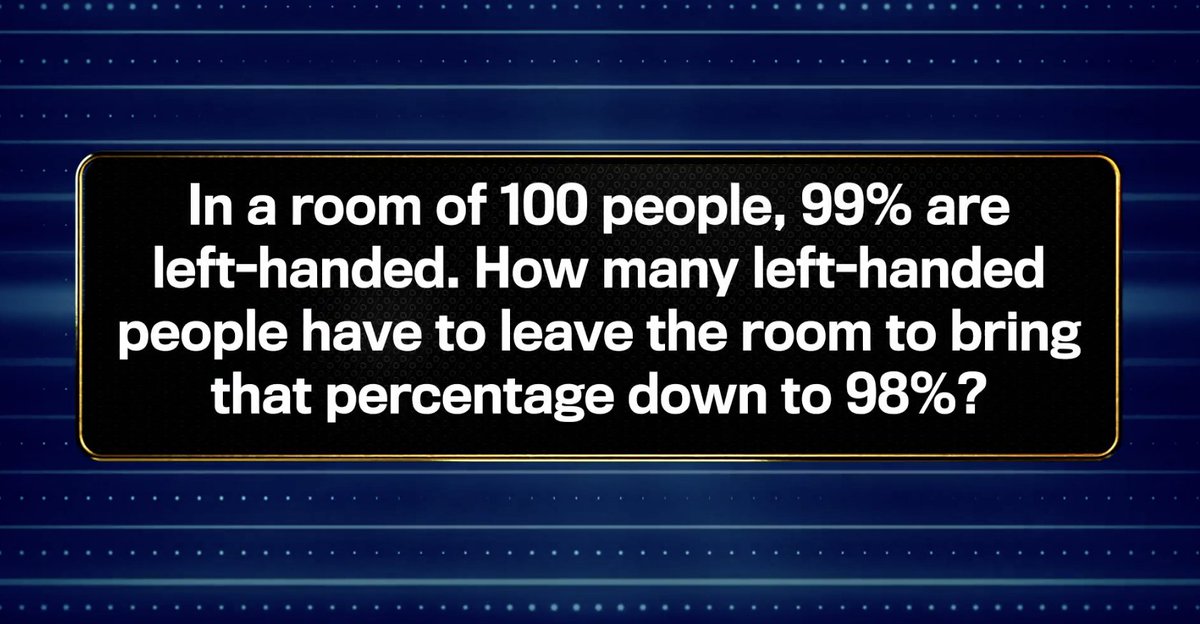
The question reads:
“In a room of 100 people, 99% are left-handed. How many left-handed people have to leave the room to bring that percentage down to 98%?”
Give yourself a moment before scrolling any further.
There are 100 people in the room.
If 99 percent are left-handed, that means 99 people are left-handed and just one person is right-handed.
The target is only 98 percent.
So how many of those 99 left-handed people need to walk out?
It certainly sounds as though the answer ought to be one.
After all, we’re only trying to reduce the percentage by a single percentage point.
But that’s not how the numbers work.

Why one person isn’t the answer
Suppose one left-handed person leaves.
You’d then have 98 left-handed people among 99 people overall.
And 98 out of 99 isn’t 98 percent.
It’s approximately 98.99 percent.
So we’re nowhere near finished.
Take out another left-handed person and you’re left with 97 out of 98.
That’s still roughly 98.98 percent.
The percentage is falling far more slowly than you might expect because every time a left-handed person leaves, both the number of left-handed people and the total number of people in the room decrease together.
That’s the detail that makes the puzzle so deceptive.
There is still only one right-handed person in the room, and for that single person to represent two percent of everyone remaining, the total number of people needs to become much smaller.
So what’s the answer?
Eventually, the room needs to contain 50 people.
Why?
Because if the original right-handed person remains, the other 49 people are left-handed.
And:
49 ÷ 50 = 98%
The room started with 99 left-handed people.
To get down to 49, therefore, 50 left-handed people have to leave.
That’s the answer:
50 people.
@1percentclubitv Tell us the answer 👇 #The1PercentClub #quiztok #quiztime #quizchallenge ♬ original sound – The 1% Club
And it’s exactly the sort of result that feels completely wrong until you see the logic.
The percentage only changed from 99 percent to 98 percent, yet half the people in the room had to disappear to make it happen.
There’s also a much quicker way of seeing it.
At the beginning, the single right-handed person represents 1% of the room.
Nobody is asking that person to leave.
For the proportion of left-handed people to fall to 98 percent, the proportion who are not left-handed must therefore rise to 2%.
If one person represents 2 percent of the room, there can only be 50 people in the room altogether.
Which means 50 of the original 99 left-handed people need to leave.
No complicated mathematics required.
Just one percentage that behaves very differently from the way your instincts tell you it should.