My father tightened the bandages around my face on the morning of my wedding as if he weren’t preparing me for marriage, but sealing me inside a prison he had built before I could even speak.
“Remember, Sofia,” Victor Valez whispered, smoothing the white fabric over my cheeks with hands that never trembled, “a husband may love you today, but the world will destroy you tomorrow if it sees what you truly are.”
I had heard those words my whole life, first beside my crib, then beside the school windows I wasn’t allowed to open, then beside the mirrors he kept covered with heavy velvet cloths. He said I was born with a terrible facial condition, something so rare and frightening that even kind people would stare at me, laugh, and end up hating me, and since I had no mother to tell me otherwise, I believed him.
My mother, Helena, had died when I was a baby, or at least that was the story my father always told me whenever I asked why there weren’t any photographs of her in the house. He kept a silver locket locked in his office, and sometimes, late at night, I would hear him holding it and crying with such deep grief that it made me forgive every locked door and every forbidden question.
Then Adriano entered my life like sunlight through a crack in the wall.
He was a quiet architect from Lisbon who restored old buildings, and when he met me at a charity gala, he didn’t ask why my face was covered. He only asked if I liked music, and when I confessed that I had never danced in public, he extended his hand as if the bandages were the least important detail about me.
For six months, he loved me tenderly. He brought me books, listened to my thoughts, and never tried to touch the cloth over my face, although sometimes I perceived sadness in his eyes when my father answered questions meant for me. When Adriano asked for my hand in marriage, my father agreed too quickly, with a smile so thin it startled me.
The only discussion before the wedding was about the guest list.
“No one from your mother’s side of the family,” my father said sharply, crossing out a name I had never seen.
Adriano’s eyes went to the paper. “Clara Moretti?”
“My wife’s sister,” my father replied, folding the list before I could read any further. “A bitter woman who abandoned this family years ago.”
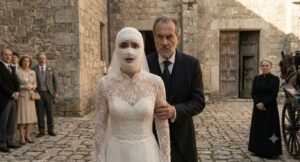
On our wedding day, the old stone courtyard seemed like something out of a dream, with candles flickering along the aisle and white flowers climbing the arches, but as my father led me forward, the silence around us felt heavier than any veil.
People stared.
A woman covered her mouth. A man leaned toward his wife. Someone gasped softly as the wind lifted the edge of my veil, revealing the tight bandages beneath.
Adriano was under the flowered arch, his hands clasped in front of him, but he wasn’t just looking at my covered face. He was looking at my father’s fingers digging into my arm.
When we reached him, Adriano leaned close enough for only me to hear. “Sofia, are you afraid of me?”
My father’s grip tightened before I could answer.
“She’s too emotional,” Victor said, his voice polished and cold. “Go on.”
But Adriano didn’t look at the priest. He looked at me, then at my father’s hand, and something changed in his face, as if he had finally seen the prison instead of just the cloth that covered it.
PART 2
During the vows, my voice trembled so much that even the priest hesitated. When Adriano placed the ring on my finger, his thumb brushed against a loose corner of the bandage near my jaw, and beneath it he saw a narrow strip of ordinary skin.
His eyes slowly lifted.
After the ceremony, before my father could take me to the waiting car, Adriano held my hand and said, “I want a minute with my wife.”
Victor smiled at the guests, but his whisper cut like glass. “You don’t understand what you’re asking.”
“No,” Adriano said quietly. “I think I finally understand.”
He led me to a small chapel beside the courtyard, where the candlelight flickered against the stone walls and a bare mirror hung above an old wooden table. My reflection was merely a white form in bridal lace, a ghost pretending to be a woman.
My fingers crept up to my face, but years of obedience were choking me.
Then the chapel door opened.
Victor stood there, pale and furious, but behind him came an older woman in a dark green dress, walking slowly with a cane. Her eyes filled with tears the instant she saw me.
“Sofia?” she whispered. “Helena’s daughter?”
The woman was Clara Moretti.
Adriano had discreetly invited her after seeing how violently my father had reacted to her name, and Clara had arrived with an old envelope, a silver medallion, and trembling hands as she placed everything on the table.
First, she unfolded a photograph of my mother on her own wedding day. Helena was gazing at me, young and radiant, with my identical chin, my identical mouth, and a small crescent-shaped birthmark near her left temple.
Then Clara opened the silver locket that my father had hidden for years, and inside was another photo of Helena holding a baby wrapped not in bandages, but in a soft pink blanket.
Eu.
“There was nothing wrong with her face,” Clara said, her voice breaking. “Her mother wrote in those letters that he controlled what she wore, who she spoke to, and even which windows she was allowed to open. The night she died, she was trying to leave.”
Victor sank into the chapel pew, and for the first time in my life he seemed less like a wall and more like a man crushed beneath one.
“I didn’t want her to fall,” he whispered. “But seeing you grow up with her face suffocated me. I told myself I was protecting you from the world, but I was only protecting myself from seeing her face again.”
“You didn’t protect me,” I said, my voice trembling. “You erased me.”
Adriano didn’t remove the bandages for me. He just stayed by my side while I untied the first knot myself, and when the fabric finally fell away, the woman in the mirror was neither a monster, nor a curse, nor a shameful secret.
It was me.
In the following weeks, Clara gave Adriano the letters my mother had written before she died, and the truth my father had buried began to surface, piece by piece. Victor lost the family name he had defended so fiercely, but I also lost something: the father I had spent my whole life trying to love.
Still, when I stood before the chapel door with my face uncovered and my hands trembling, Adriano squeezed my fingers and waited.
Freedom seemed almost as terrifying as fear.
Then I returned to the courtyard, no longer as the bride in bandages, but as Sofia Helena Valez, and every whisper died when I smiled.