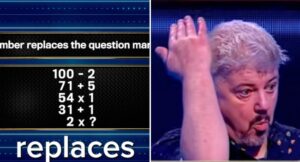
The 1% Club’s £97,000 final looked like basic school maths — but the contestant admitted he had ‘not a clue’ how to solve it
One player was left with a brutal decision: bank £10,000 or risk it on a sequence that looks far simpler than it really is
Sometimes walking away from The 1% Club takes almost as much nerve as playing on.
After surviving question after question while the rest of the studio fell away, contestant Clint found himself as the only player remaining in the game.
Waiting for him was a potential £97,000 jackpot.
But first he had to make one enormous decision.
Clint could take the guaranteed £10,000 and leave.
Or he could put that money on the line and attempt the dreaded 1% question.
Then came the puzzle.
And at first glance, it looked like something most people might expect to see in a school maths exercise.

The £97,000 question
Clint was shown five lines:
100 – 2
71 + 5
54 × 1
31 + 1
2 × ?
The question was simply:
“Which number replaces the question mark below?”
That’s it.
No lengthy instructions. No obscure trivia. Just some extremely basic arithmetic and one missing number.
But this is The 1% Club, where apparently simple questions have a habit of becoming considerably less friendly once that 30-second clock starts ticking.
So before reading any further, look at the puzzle in the image and make your own decision.
What replaces the question mark?

Clint had already made his decision
Fortunately for Clint, he didn’t actually have to solve it.
As the only contestant to reach the final, he had already been offered the choice between gambling for the £97,000 jackpot and taking the guaranteed money.
He chose the latter.
£10,000 was enough.
Lee Mack nevertheless allowed him to see the 1% question and have a go for fun.
It quickly became apparent that walking away had been a pretty useful decision.
According to reports of the episode, Clint admitted he had “not a clue” how to solve it.
But watching from the sofa, without £10,000 riding on your answer, you have a little more freedom to experiment.
And there are plenty of tempting places to start.
Perhaps the first numbers — 100, 71, 54, 31 and 2 — form a sequence.
Maybe the operations matter: minus, plus, multiply, plus, multiply.
Maybe you’re supposed to manipulate the digits.
All of those approaches can send you down a rabbit hole.
Because the important numbers aren’t necessarily the ones you see before doing the calculations.

Try actually solving every line
This is the point to stop if you’re still working on it.
The trick begins to emerge when you do the extremely simple arithmetic the question puts in front of you.
The first line gives:
100 – 2 = 98
Then:
71 + 5 = 76
And:
54 × 1 = 54
Followed by:
31 + 1 = 32
Now forget how those answers were produced and put the results underneath one another:
98
76
54
32
?
Suddenly, the pattern becomes much easier to see.
@1percentclubitv **pulls out the GCSE maths book** #the1percentclub #leemack #itv #quiz #quizshow #quiztok ♬ original sound – The 1% Club
The answer is 5
The results are counting backwards through the digits:
98 76 54 32 10
Or, pushed together:
9876543210
That means the final calculation has to equal 10.
The last line is:
2 × ? = 10
Therefore:
? = 5.
That’s the answer.
And it’s a particularly satisfying The 1% Club trick because every individual calculation is almost absurdly easy.
The difficulty comes from recognising that you’re supposed to calculate all of them first and then stop treating them as separate sums.
Once you see 98, 76, 54, 32, the countdown to 10 is difficult to miss.
Before that moment, however, the unusual combination of numbers and mathematical symbols encourages you to search for a much more complicated rule.
Xem bài viết này trên Instagram
Clint’s £10,000 decision suddenly looked rather sensible
The episode therefore produced one of those unusual The 1% Club endings where the final contestant didn’t need to answer correctly to leave as a winner.
Clint had already protected his £10,000 before discovering what the 1% question would be.
And after seeing it and admitting he didn’t know the solution, there could hardly have been better confirmation that taking the guaranteed money had worked in his favour.
For viewers, though, there’s no £10,000 decision to worry about.
Just 30 seconds, five tiny calculations and one deceptively well-hidden countdown.
And like so many of the show’s best puzzles, 5 looks ridiculously obvious — but only after someone shows you why.