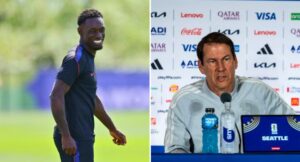
FIFA’s appeal committee denied Belgium’s appeal of its decision on Folarin Balogun’s red card, meaning the U.S. men’s national team star can indeed play against Belgium.
“The request was rendered inadmissible on the grounds that the RBFA [Royal Belgian Football Association] is not a party to the proceedings and, as such, has no standing to appeal the decision,” FIFA said in a statement.
That is not an end to this extraordinary set of events, which has come to involve President Trump after he called FIFA president Gianni Infantino to — depending on who you believe — either request an explanation for Balogun’s red card or request that it be overturned.

Indeed, the RBFA’s statement in response to the decision saying that it “has informed the United States Soccer Federation that it contests the eligibility of the player [Balogun], should the player be listed on the referee’s team sheet. This leaves all further options open.”
Infantino himself released a statement Monday morning, stressing the independence of FIFA’s judicial bodies while confirming he received a call from President Trump.

“During our conversation, I explained that there was an ongoing legal process involving FIFA’s independent judicial bodies and that the case would be decided in due course by competent bodies,” Infantino said. “That is how FIFA’s system works, and it is a principle that I will always uphold.
“I read the decisions of the FIFA Disciplinary Committee when they are issued. Sometimes I am surprised by them. Sometimes I agree with them, and sometimes I disagree.

“What I always do, however, is respect those decisions and the autonomy of the bodies that make them. Whether we personally like a decision or not is irrelevant. Respect for independent institutions and the rule of law is what protects the integrity of our competitions and the credibility of FIFA at all times.”
That did little to stem the outrage from Belgium and from UEFA, the sport’s European governing body, which put out a statement condemning the decision.
“When the certainty of rules is no longer guaranteed by its guardians, the integrity of the game is at stake and the credibility of a competition is undermined,” UEFA’s statement read. “Equally, such decision creates a precedent in the ongoing tournament, where similar situations will now require an equal treatment, to the detriment of competition.”
On that note, the French Football Federation appealed to FIFA Monday morning to rescind Michael Olise’s yellow card from its win over Paraguay on Saturday.
“We express our disbelief at such an unprecedented, incomprehensible and unjustifiable action,” UEFA’s statement finished.
Notably, there was no such outrage from the governing body after FIFA used the same Article 27 to defer two games of Cristiano Ronaldo’s red-card ban in November, ensuring he could play in the group stage at the World Cup. FIFA did publish a disciplinary verdict explaining its judgment in that case, though, something it hasn’t done in relation to Balogun.
Prior to its appeal being denied, the RBFA released a statement saying it had learned of the decision to suspend Balogun’s suspension via media reports, and then requested an explanation of the process and a copy of FIFA’s decision.
That, according to the RBFA, was met with a response from FIFA saying the request constituted an appeal, which the federation “had only a few hours to complete.
“While the RBFA was merely seeking legitimate explanations, FIFA itself created an appeal and immediately ensured that it would be declared inadmissible,” the federation said.
“… To be clear as of this moment, the RBFA has still not received any decision or explanation from FIFA regarding this matter. It therefore has no alternative but to challenge the player’s eligibility for the upcoming match.
“Regardless of the sporting outcome of this match, the RBFA is deeply concerned by the course of events and will continue to fight in the coming hours, days and months in defence of the fundamental principles of ethics, fair competition, and the interests of football as a whole.”