‘HARDEST EVER’ The 1% Club Question Sent 32 Contestants Crashing Out In One Of The Show’s Biggest Eliminations
One deceptively simple question on The 1% Club left dozens of contestants out of the running, with 32 people eliminated after failing to spot a crucial detail. Even quiz host Lee Mack was struck by the number of players who got it wrong, describing the result as “massive”.
The ITV quiz show is designed to become progressively harder as contestants work their way through questions that fewer and fewer people can answer correctly. But some of the most memorable moments come when a question catches a large portion of the remaining players off guard, wiping out their chances of winning.
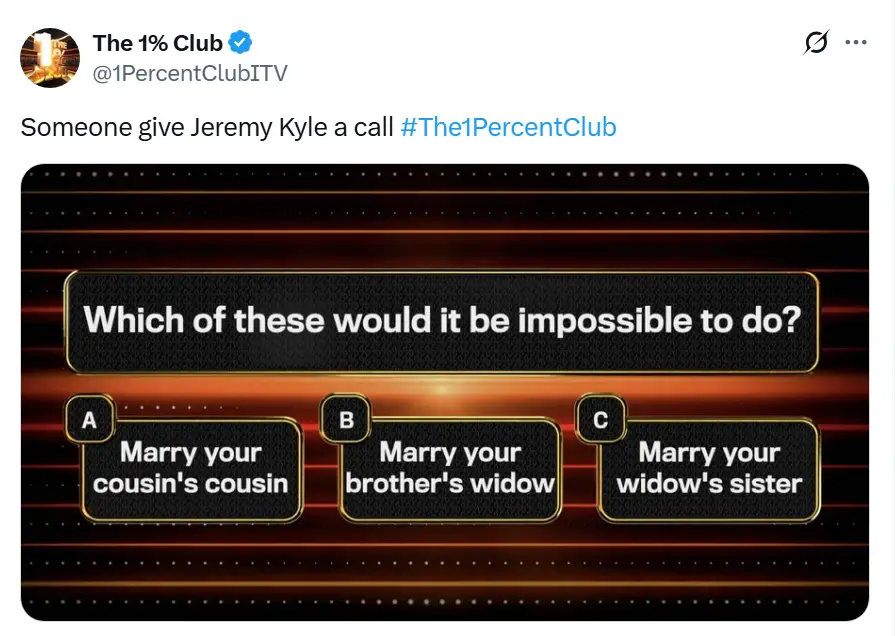
This particular brainteaser was a 40% question, meaning it was expected to challenge a substantial number of participants. Yet the number of people who failed to find the correct answer made it one of the most dramatic rounds in the programme’s history.
Can You Solve The Question In 30 Seconds?
Before discovering the answer, viewers can put their own reasoning skills to the test. Set a timer for 30 seconds and see whether you can work out the solution before time runs out.
The key to this question lies in the wording itself. As with many of the show’s trickier puzzles, the answer becomes much clearer once you pay close attention to the language used rather than rushing into a conclusion.
The correct answer was C.
The explanation hinges on the phrase “your widow”. If you had a widow, you would already be dead, meaning you could not marry anyone. Spotting those two words is enough to unravel the trick and identify the right option.
Although the logic is straightforward once explained, that did little to help the contestants who faced the question under pressure. A total of 32 players selected the wrong answer and were eliminated from the competition.
Mack highlighted just how many people had fallen for the trap as he explained why option C was correct. The mass elimination made the question stand out as one of the biggest losses of contestants in the show’s history.
Anyone who managed to solve it within the allotted time had good reason to feel pleased with themselves.
Another Question Eliminated 30 Contestants
The 40% brainteaser was not the only question to cause a major shake-up in the competition. Another challenge, this time a 60% question, also proved difficult enough to send a large group of contestants home.
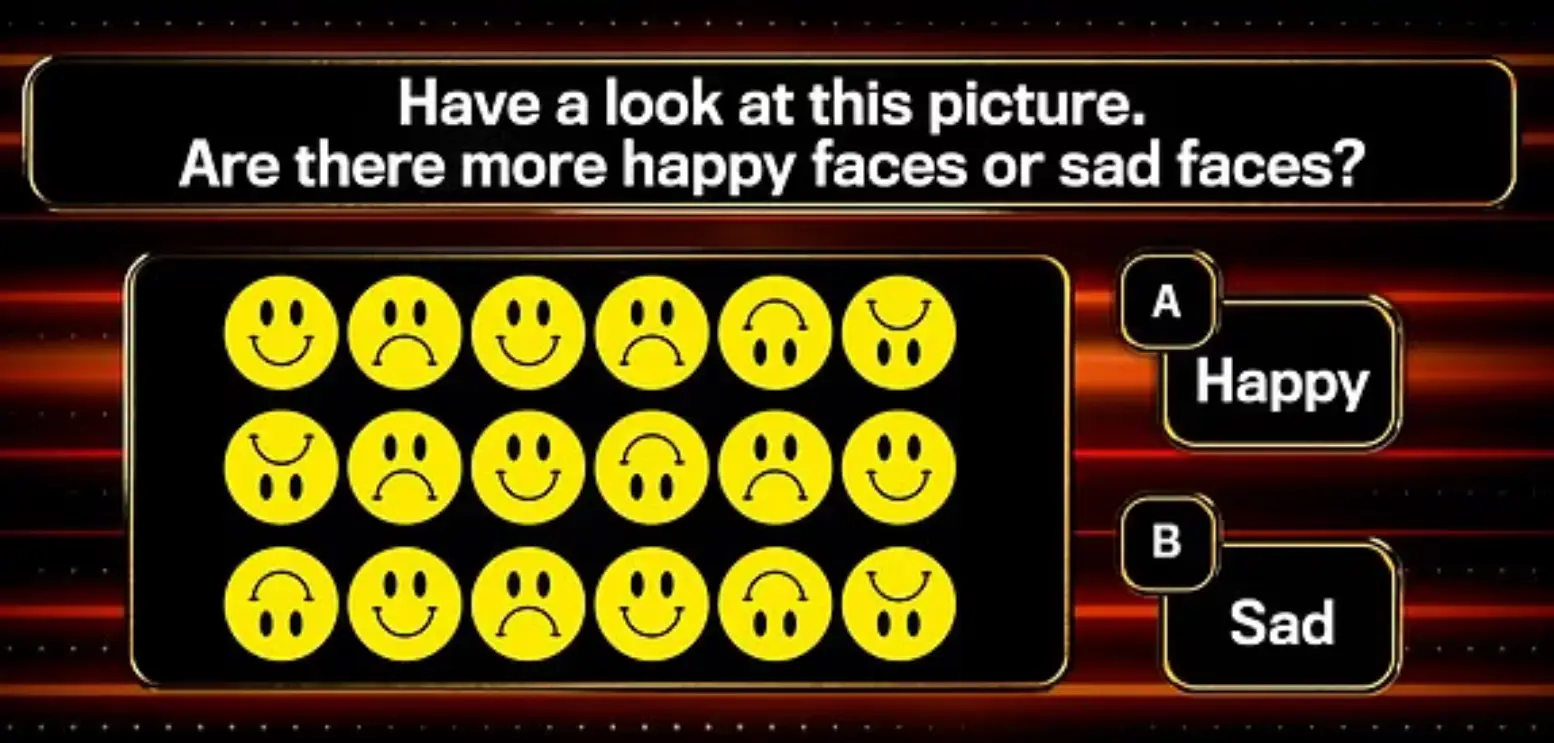
This puzzle featured a total of 18 faces, with 10 showing happy expressions. The task was to identify the correct answer from the information presented.
The answer was happy, but 30 contestants failed to reach that conclusion and were eliminated from the game.
With only 30 seconds available, players had to take in the details, count the faces correctly and avoid being distracted by the apparent simplicity of the task. Missing even one important detail could mean the difference between progressing to the next round and leaving the competition.
Mack was astonished by the number of people who got the answer wrong. He responded with a joke about the outcome, remarking that “there’s 30 sad ones now”.
The result provided another example of how quickly a seemingly manageable question can change the course of the game.
Why The Hardest Questions Catch So Many People Out
On The 1% Club, questions that eliminate the largest numbers of contestants often earn a reputation for being among the show’s hardest. Their difficulty does not necessarily come from complicated calculations or obscure knowledge. Instead, success can depend on noticing a small detail that other players overlook.
The pressure of a strict time limit makes these puzzles even more challenging. Contestants have to interpret the question, consider the possible answers and commit to a choice before the clock reaches zero.
As the programme progresses, the challenges become increasingly difficult, even for the small group of players who survive the earlier rounds. The final questions can demand a level of concentration that leaves even confident contestants struggling to find a solution.
Some viewers have gone as far as describing certain puzzles as “impossible” to solve before the time runs out.
For those watching at home, however, there is an advantage: they can attempt the questions without the added pressure of competing for a prize in front of the studio audience.
Still, the fate of those 32 contestants serves as a reminder that a question does not need to look complicated to be unforgiving. Sometimes, all it takes is two easily overlooked words to bring an entire run on The 1% Club to an abrupt end.