The 1% Club question looks like a bizarre secret code until you realise what the symbols really are
The strange-looking sequence is much simpler than it first appears – but you have to stop seeing the symbols as symbols
There are some The 1% Club questions where knowing more doesn’t necessarily help you.
In fact, thinking too hard can be exactly what sends you in the wrong direction.
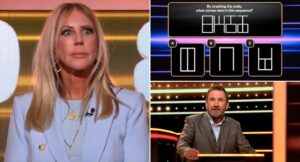
One particularly clever puzzle presented contestants with a sequence of four strange-looking symbols and asked them to “crack the code” to work out what should come next.
And considering the question was answered correctly by just 15 percent of the people surveyed for the show, you might want to see whether you can spot what’s going on before reading any further.
Unlike a traditional quiz show, The 1% Club isn’t built around remembering obscure facts or knowing who won a particular sporting event decades ago.
Instead, contestants have to rely on logic, observation and lateral thinking as the questions become progressively tougher.
Which brings us back to those symbols.
The sequence looks like this:

And there are three possible answers: A, B or C.
Give yourself 30 seconds.
At first glance, there’s plenty to overthink.
Maybe the number of vertical lines matters. Perhaps each symbol is being constructed from the one before it. Or maybe you’re supposed to track which parts of each shape move from one position to another.
But there’s a much easier way into the puzzle.
The clue is right there in the instruction: “cracking the code.”
Still stuck?
Before revealing the answer, try looking at the sequence again without treating the shapes as completely new symbols.
Because they’re actually something you’ve seen thousands of times before.
The answer is B.
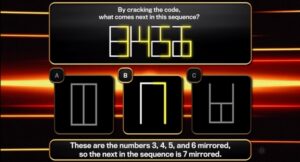
The symbols are simply familiar numbers that have been mirrored.
Once you recognise the first one as a reflected 3, the whole sequence suddenly falls into place.
You’re looking at:
3 – 4 – 5 – 6
Each number has been flipped to create the unusual symbols on screen.
That means the next number must be 7, treated in exactly the same way.
And among the three options, B is the mirrored seven.
It’s the sort of explanation that makes the puzzle go from looking completely baffling to almost annoyingly straightforward in a matter of seconds.
There isn’t a complicated equation to solve. There isn’t a hidden mathematical relationship between the shapes. And you don’t need to count the lines.
You just need to recognise what you’re looking at.
That’s also what makes questions like this particularly dangerous on The 1% Club.
The more the symbols look like an unfamiliar “code”, the more tempting it becomes to search for an equally complicated way of decoding them.
But sometimes the difference between getting through and getting knocked out is simply being able to look at the exact same image from a different perspective.
And if you picked B without needing the explanation, you just managed a question that only 15 percent of those surveyed were expected to get right.
@realityclubfox Yikes! That was a tough one! #The1PercentClub #PattonOswalt #trivia #gameshow #guessing ♬ original sound – Reality Club FOX