Celtic Thunder: The Versatile World Music Icons

Few vocal groups have built a career around Irish and Celtic music quite like Celtic Thunder. Since making their debut at Dublin’s Helix in 2007, the ensemble has combined traditional songs, contemporary hits and theatrical staging into a distinctive live format that has taken them from Ireland to audiences across North America and beyond.
The group was created by producer Sharon Browne and musician Phil Coulter as a male counterpart to the successful Celtic Woman project, with which Browne had been involved. Their first performance took place at The Helix in Dublin in August 2007, establishing the template that would define Celtic Thunder: multiple lead singers sharing the stage, moving between solo performances, duets and full-group numbers.
That debut production soon became a CD and DVD, Celtic Thunder – The Show, released in March 2008. The release proved highly successful and helped introduce the group to a much wider audience. Celtic Thunder subsequently began touring extensively in the United States and Canada while continuing to release new recordings and television specials.
From Dublin to the World
Celtic Thunder’s popularity grew rapidly in the years that followed. Billboard named the group its Top World Album Artist in 2008, 2009 and 2011, while their early releases established a strong presence on the World Albums chart.
Their growing profile was also reflected outside the charts. In 2009, Celtic Thunder opened New York City’s Saint Patrick’s Day Parade, an especially fitting appearance for a group whose repertoire drew so heavily on Irish heritage.
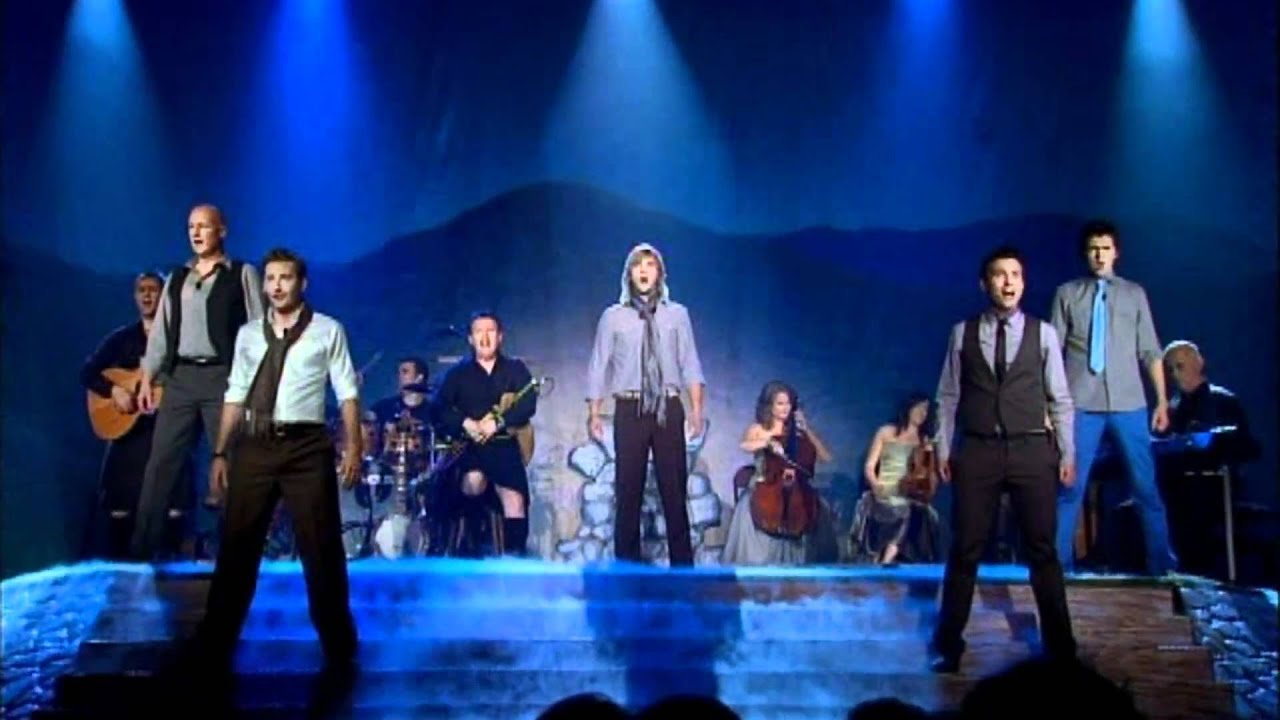
Their concerts were designed as more than straightforward vocal performances. Each principal could take the spotlight alone before returning to the ensemble, while duets and larger arrangements gave the shows a theatrical, constantly changing character.
That versatility is particularly evident in two performances that showcase very different sides of the group.
Colm Keegan and Keith Harkin Take on “The Sound of Silence”
In The Sound of Silence, Keith Harkin and Colm Keegan demonstrate how effectively Celtic Thunder’s singers could build a performance around two voices.
The song was recorded for the group’s ninth television special and released on Mythology in 2013. The production was filmed at The Helix in Dublin — the same venue where Celtic Thunder had first performed in 2007. The Mythology release featured Harkin and Keegan on “The Sound of Silence” alongside other principal singers including George Donaldson, Ryan Kelly, Emmet Cahill and Neil Byrne.
What makes the performance stand out is its gradual rise in intensity. Harkin and Keegan begin by allowing the vocals to carry the song before the arrangement expands and the full orchestra adds another layer of power.
It is a useful reminder that Celtic Thunder’s appeal was never based solely on spectacle. The individual voices had to work on their own, and the arrangement then provided the scale associated with the group’s larger productions.
“Amazing Grace” Without the Orchestra
If The Sound of Silence highlights the power of a carefully built orchestral arrangement, Amazing Grace offers almost the opposite experience.
Recorded as an a cappella performance for Celtic Thunder Christmas in 2015, the hymn strips the presentation back and puts the singers themselves at the centre. Without an orchestra providing the musical foundation, the harmonies and individual voices become much more exposed.
The performance also carries an especially poignant connection to Celtic Thunder’s history.
George Donaldson, affectionately known as “Big George,” had died suddenly at the age of 46 after suffering a heart attack at his home in March 2014. He had joined Celtic Thunder after impressing producers Sharon Browne and Phil Coulter and became one of the group’s best-known performers.
In Amazing Grace, Donaldson delivers the final solo. That detail gives the performance an added emotional weight, particularly for longtime followers of the group.
Two Musical Eras
For some longtime Celtic Thunder fans, the group’s history can be viewed through two distinct musical eras: the years when Phil Coulter served as musical director and the period that followed his departure in 2011.
Coulter was deeply involved in Celtic Thunder from its creation. He helped with the casting, original material and repertoire and served as musical director during the group’s formative years. He has described the project as one of his major musical priorities and credited its success in the United States with turning the ensemble into a phenomenon.
David Munro took over as musical director in 2011. A graduate of Glasgow University, Munro began his career as a concert pianist before moving into ballet and opera. His work has included collaborations with organizations such as The Royal Ballet, Scottish Ballet, Miami City Ballet and London Contemporary Dance Theatre.
With Celtic Thunder, Munro became responsible for the group’s musical and vocal arrangements across productions including Voyage, Mythology, Celtic Thunder Symphony, Very Best of Celtic Thunder and Legacy.
That transition was noticed by some fans. One longtime supporter quoted in the original discussion felt that the change in musical direction meant something was missing compared with Coulter’s earlier work, describing Coulter’s sound as having a distinctive, almost spiritual quality.
Whether listeners preferred one period over another, Munro’s contribution established its own identity within Celtic Thunder’s catalogue.
Phil Coulter’s Musical Legacy
The contrast between the two directors is also rooted in their very different musical backgrounds.
Munro developed much of his career through classical performance, ballet and contemporary dance, while Coulter made his name as a songwriter, arranger and producer in popular music.
Coulter’s songwriting partnership with Bill Martin was particularly successful. The pair wrote “Puppet on a String,” performed by Sandie Shaw when the United Kingdom won the Eurovision Song Contest in 1967. They also collaborated on “Congratulations,” among numerous other successful songs. Coulter’s own account of his career notes that the partnership produced songs that sold more than 10 million records.
That background helps explain the broad musical palette Coulter brought to Celtic Thunder. The group was never confined to one narrow interpretation of Celtic music; traditional Irish material could sit alongside pop standards, theatrical numbers and contemporary songs.
A Group Built Around Its Voices
Ultimately, Celtic Thunder’s greatest strength has been the flexibility of its performers and arrangements.
The group can move from the expansive sound of a full orchestra to stripped-back harmony, from individual solos to tightly coordinated duets and full-ensemble performances. The Sound of Silence demonstrates the dramatic potential of that larger sound, while Amazing Grace reveals what happens when the singers are left to carry the arrangement themselves.
That range has remained central to Celtic Thunder’s identity. The group’s official history records a continuing catalogue of albums, television specials and tours, with Mythology marking a return to The Helix in Dublin for another major filmed production in 2013.
For listeners discovering Celtic Thunder through these performances, the appeal is easy to understand: the spectacle may draw the audience in, but it is the voices — individually and together — that ultimately define the experience.