Visuals Disguised as Arithmetic: How The 1% Club’s “1471” Puzzle Traps Contestants into Mathematical Overthinking
One of the signature hallmarks of ITV’s The 1% Club is presenting challenges that masquerade as complex arithmetic while hinging entirely on visual perception. A prime example is the deceptive “1471” sequence, which leaves viewers and contestants attempting intricate numerical formulas before realizing the answer requires counting pen strokes rather than calculating values.
The Setup: Four Identical Digits, Conflicting Totals
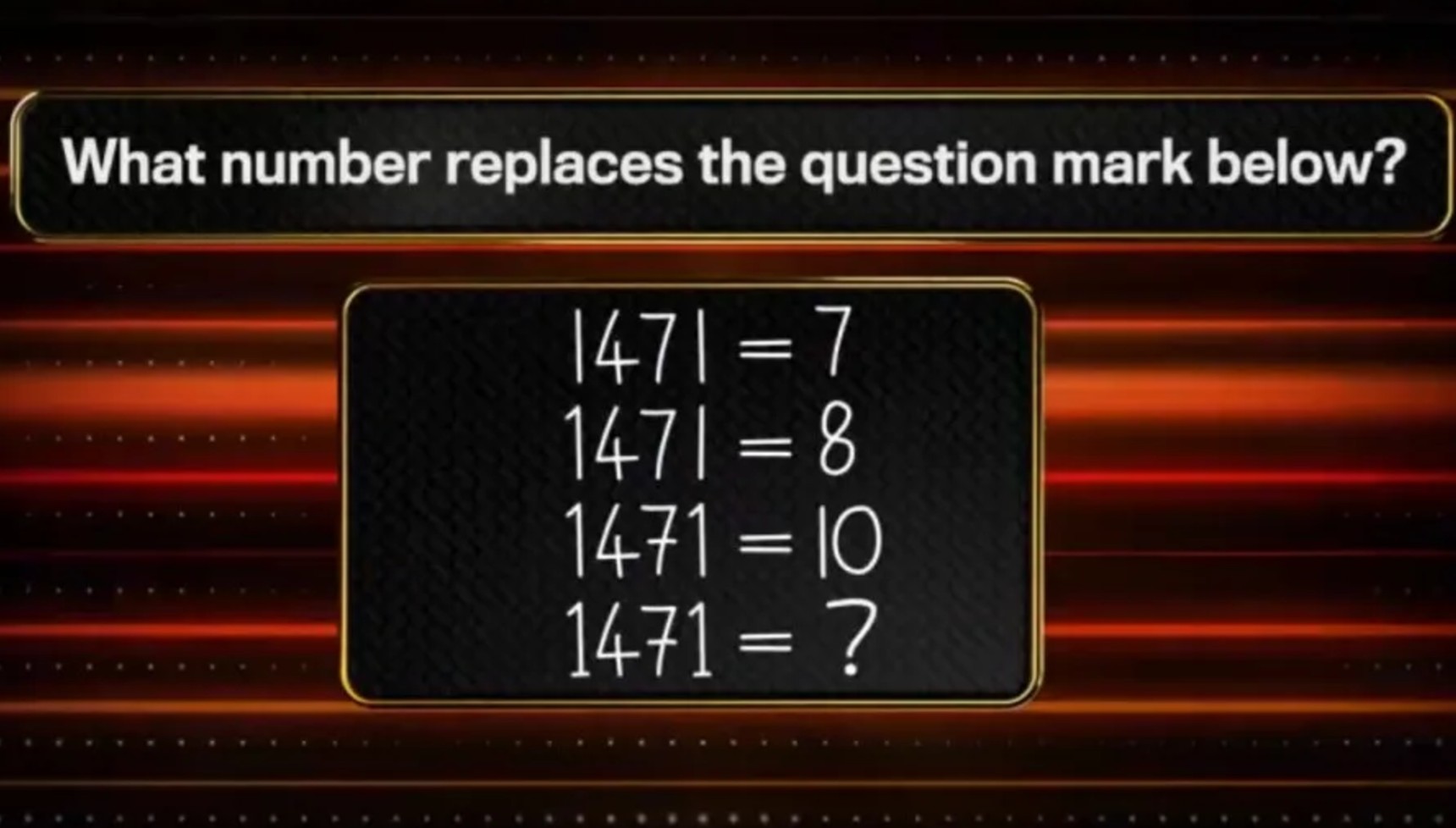
Contestants are given 30 seconds to determine the missing value in this four-row progression:
The Puzzle:1471 = 71471 = 81471 = 101471 = ?
The Mathematical Rabbit Hole

At first glance, the premise appears mathematically impossible:
-
The Sum Fallacy: Adding the digits together ($1 + 4 + 7 + 1 = 13$) fails to match any row on the right-hand side.
-
The Sequence Trap: Looking only at the right-hand column ($7, 8, 10\dots$) leads many players to guess $+1, +2, +3$ increments, jumping to $13$ without understanding why the baseline numbers exist.
-
The Core Misdirection: The brain interprets “1471” as a fixed numerical value rather than four graphic characters drawn with varying levels of detail.
The Solution: Counting the Pen Strokes

The key to solving the riddle lies in examining the physical typography of the digits in each row. The number on the right indicates the total number of individual straight lines (strokes) used to draw the digits:
-
Row 1 ($= 7$):
-
Simple
1: $1$ stroke (single vertical line) -
Standard
4: $3$ strokes (vertical, horizontal, vertical) -
Standard
7: $2$ strokes (top bar, diagonal) -
Simple
1: $1$ stroke -
Total: $1 + 3 + 2 + 1 = \mathbf{7}$
-
-
Row 2 ($= 8$): One digit gains an additional stroke (such as an added serif on a
1or a European crossbar on the7), lifting the count to $\mathbf{8}$. -
Row 3 ($= 10$): Additional strokes (top ticks, bottom bases, crossbars) increase the stroke total to $\mathbf{10}$.
-
Row 4 ($= ?$): All digits are drawn in their most complete, serifed configurations:
-
Both
1s include a top flag and bottom base ($3$ strokes each $= 6$). -
The
7includes a top flag, diagonal, and horizontal crossbar ($3$ strokes). -
The
4uses its standard $3$ strokes. -
Final Stroke Count: 12
-
Line-by-Line Breakdown

| Row Display | Visual Condition of Digits | Stroke Calculation | Output |
| Line 1 | Minimalist/basic strokes | $1 + 3 + 2 + 1$ | 7 |
| Line 2 | One additional stroke/crossbar introduced | $7 + 1$ stroke | 8 |
| Line 3 | Additional serifs/crossbars added | $8 + 2$ strokes | 10 |
| Line 4 | Fully serifed and cross-barred digits | Complete stroke count | 12 |
The Takeaway
The puzzle illustrates why time pressure on The 1% Club proves so costly: the moment a player attempts to treat the digits as an equation, they move further away from the visual reality. Success on the show consistently rewards lateral observation—noticing how something is rendered rather than assuming what it calculates to.